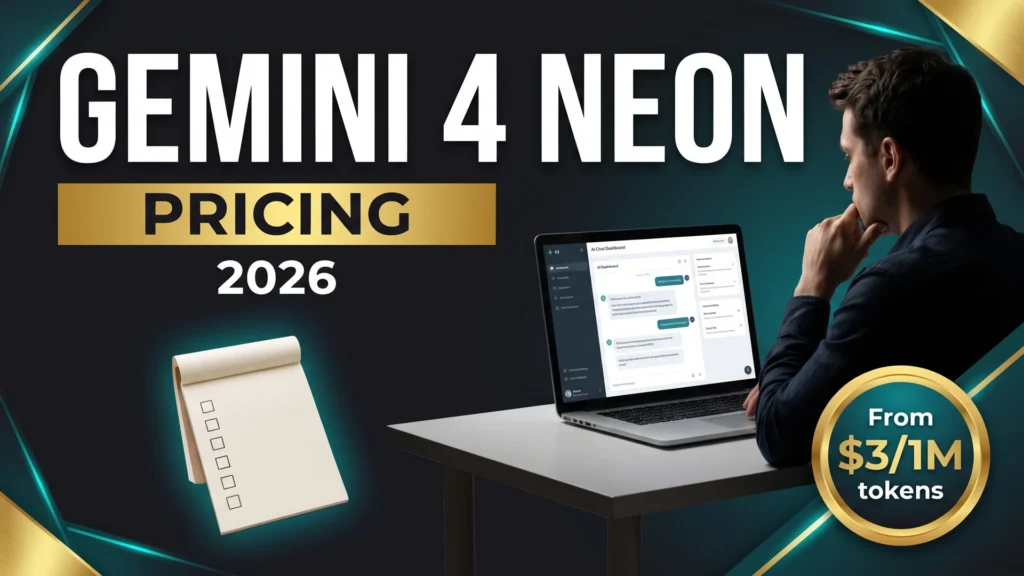
Gemini 4 Neon Pricing in 2026: $3/1M Tokens and the December 1 Price Flip
Quick note before we start: this article about Gemini 4 Neon has no affiliate links in it. Google doesn’t run an affiliate program for Gemini, so there’s nothing for me to earn here — this one is purely useful, or at least I hope so. Prices checked November 21, 2026.
Google has now launched four Gemini 4 models in about seven weeks, and I’ll be honest — keeping track of them is starting to feel like a part-time job. Argon, Carbon, Hydrogen, and now Neon, announced on November 18, 2026. Each one has its own price, its own job, and its own place in the Gemini app. And Neon is the weird one, because for the next ten days it’s the second-most-expensive Gemini 4 model — and then, on December 1, it suddenly isn’t. If you pick the wrong model this week, you could end up paying more for a weaker model. That’s the whole story of this article, really: a price flip is coming, and Neon sits right in the middle of it.
Let me walk you through what Neon costs, what it can actually do, how it stacks up against Carbon, Hydrogen, Claude, and GPT, and whether you should bother with it at all.
The short version
Gemini 4 Neon launched on November 18, 2026. It’s Google’s mid-tier Gemini 4 model — smarter than Hydrogen, lighter than Carbon — built for complex coding, knowledge work, and science tasks that need to actually finish. On the API it costs $3 per million input tokens and $15 per million output tokens, with cached input at $0.15. There’s no free tier: every token is billed, including thinking tokens. It has a 1-million-token context window, four thinking levels, and a March 2026 knowledge cutoff.
Here’s the part that matters most. Right now, Carbon costs $2 per million input tokens — cheaper than Neon. But Carbon’s price doubles to $4 on December 1, 2026, while Neon stays at $3. So from December 1, the ladder reads: Hydrogen $1.50, Neon $3, Carbon $4. Neon becomes 25% cheaper than Carbon overnight, without changing a thing. If you’re choosing a model for a project that runs past December, that flip is worth knowing about before you build anything.
And if you never touch an API, Neon still reaches you: it’s the new “deeper analysis” option in the Gemini app for Pro and Ultra subscribers, replacing Argon in the app picker. Pro costs $19.99 a month. No affiliate link here — Google doesn’t have one for Gemini, and the “Gemini” affiliate program you’ll find on some networks belongs to a crypto exchange with the same name. Different company. Don’t mix them up.
What Gemini 4 Neon actually is
Google announced Neon on its blog on November 18, 2026, in a post by Koray Kavukcuoglu, Google DeepMind’s senior vice president and chief AI architect. The pitch, in Google’s words, is “frontier-level intelligence with fast end-to-end task completion across complex software engineering, knowledge work, and science workflows.” That’s marketing language, so let me translate: Neon is the model you reach for when Hydrogen isn’t smart enough and Carbon is too slow or too expensive for the job.
The family now has a clear shape, and it’s worth getting this straight because Google keeps shuffling the names. Hydrogen is the fast, cheap, everyday model — the one that powers Gemini Tasks and the “everyday help” option in the app. Carbon is the heavyweight, built for the hardest, longest-horizon reasoning. Argon is the efficient frontier model that sits close to Carbon. And Neon, adapted from Carbon according to the model card, sits between Carbon and Hydrogen: deeper than Hydrogen, quicker and cheaper than Carbon. Google says it “balances depth and efficiency,” which is the kind of phrase that sounds vague until you look at the prices — then it starts to make sense.
Neon is multimodal on the input side: text, images, audio, video, and PDFs all go in. Output is text only, so this isn’t the model for generating pictures or video. It has a unified 1-million-token context window (1,048,576 tokens, to be exact), which is shared across input, thinking, and output — so the thinking tokens eat into the same budget as everything else. The maximum output is 65,536 tokens in a single synchronous response, though Google says you can get up to 1 million tokens out through background long decode, using the Interactions API with a continuation token. The knowledge cutoff is March 2026.
There are four thinking levels: low, medium, high, and xhigh, with high as the default. The higher you set it, the smarter the answers get — and the more thinking tokens you pay for, since thinking tokens are billed as output. That’s a trade-off worth remembering: Neon at xhigh is a different price from Neon at low, even for the same prompt.
One thing Neon is not, at least not yet: a cyber-defense tool for everyone. Google says a version of Neon tuned for cyber work is rolling out “in the coming days” to trusted defenders through its Fairwind Program. That’s a limited rollout, not a general launch, so don’t write about Neon as a security product you can sign up for today.
Gemini 4 Neon pricing: the full table
All prices below are from Google’s official Gemini API pricing page, checked live on November 21, 2026. They’re in US dollars, per 1 million tokens.
Standard tier
This is the default pay-as-you-go tier, and the one most people will use. Input costs $3.00 per million tokens. Output costs $15.00 per million tokens, and that includes thinking tokens — so a long reasoning chain shows up on your bill. Cached input costs $0.15 per million tokens, which Google describes as a 95% discount on the input price. The catch: caching is implicit only. Explicit caching isn’t supported for Neon, so you can’t manually pin a prompt into the cache the way you can with some other models. There’s also no separate cache-storage fee anywhere on the pricing page — I checked — so don’t let anyone tell you there’s a hidden storage charge.
Batch, Flex, and Priority tiers
If your work can wait, Batch and Flex both cut the price exactly in half: $1.50 per million input tokens and $7.50 per million output tokens, with cached input at $0.075. Batch is for jobs that don’t need an answer right now; Flex is Google’s cheaper tier for workloads that can tolerate slower or variable response times. Either way, half price is half price, and for bulk jobs like processing a pile of documents overnight, it’s the obvious pick.
Priority is the other direction: $5.40 per million input tokens and $27.00 per million output tokens, with cached input at $0.27. That’s the tier for when you need guaranteed speed and capacity, and you’re willing to pay 80% more than Standard for it. Most solo developers and small teams will never need it.
Here’s the whole table in one place:
| Tier | Input / 1M tokens | Output / 1M tokens | Cached input / 1M tokens |
|---|---|---|---|
| Standard | $3.00 | $15.00 | $0.15 |
| Batch | $1.50 | $7.50 | $0.075 |
| Flex | $1.50 | $7.50 | $0.075 |
| Priority | $5.40 | $27.00 | $0.27 |
Two things to notice. First, there’s no intro price and no expiry date on Neon’s $3/$15. Unlike Carbon and Argon, whose prices carry an explicit “through November 30” note, Neon’s price is just the price. Don’t let anyone sell you a “Neon intro offer ends soon” story — Google hasn’t published one. Second, there’s no free tier. Google’s pricing page says it plainly: “Gemini 4 Neon is not available on the Free tier.” Hydrogen is the only Gemini 4 model with a free API tier. With Neon, the meter runs from the first token.
Grounding costs extra, and it’s the same across the Gemini 4 family: you get 5,000 free Google Search grounding requests a month, shared across Gemini 3 and newer models, then $14 per 1,000 requests, with a daily cap of 1,500 requests. Google Maps grounding works the same way — 5,000 free a month, then $14 per 1,000 queries. If your app leans on grounding for every answer, that $14 per thousand adds up faster than the token bill, so keep an eye on it.
The December 1 flip: Carbon gets more expensive, Neon doesn’t
This is the part of the story that actually changes decisions, so let me lay it out carefully.
Carbon and Argon are currently on a promotional price: $2 per million input tokens and $10 per million output tokens, with cached input at $0.10. That price ends on November 30, 2026. From December 1, every tier doubles — Standard goes to $4 input and $20 output, cached input to $0.20, Batch and Flex to $2/$10, Priority to $7.20/$36. Google publishes this right on the pricing page, so there’s no mystery about it.
Hydrogen doesn’t move. It stays at $1.50 input and $7.50 output, with no end date on the page. And Neon doesn’t move either — $3/$15, flat, no date attached.
So the ladder flips. Until November 30, the ranking by input price is Hydrogen $1.50, then Carbon and Argon at $2, then Neon at $3. Neon is the most expensive of the three per token right now — 50% more than Carbon. From December 1, the ranking is Hydrogen $1.50, Neon $3, Carbon and Argon $4. Neon becomes 25% cheaper than Carbon, and exactly twice the price of Hydrogen.
Why does that matter? Because a lot of people are picking models this week for projects that will still be running in December. If you build on Carbon today because it’s the cheapest smart model, your bill doubles in ten days. If you build on Neon, your price doesn’t change at all. And if you build on Hydrogen, you’re already on the cheapest tier and it stays that way.
One honest caveat: Google doesn’t state a timezone for the November 30 to December 1 cutover on the pricing page. I won’t invent one. If your billing matters to the hour, check your own account on the day.
There’s also a real-world cost example that makes the difference concrete. Say your app processes 1 million input tokens and generates 100,000 output tokens in a day. On Neon Standard, that’s $3.00 plus $1.50 — $4.50 a day. On Carbon today, it’s $2.00 plus $1.00 — $3.00 a day, cheaper. From December 1, the same Carbon workload costs $4.00 plus $2.00 — $6.00 a day, while Neon stays at $4.50. The “cheaper” model stops being cheaper in ten days. That’s the kind of detail that only shows up if you read the dates, not just the headline numbers.
Neon vs Carbon vs Hydrogen: which one should you pick?
I’ve written about Hydrogen’s pricing before — $1.50 per million input tokens, $7.50 output, with a free tier, and it’s the model behind Gemini Tasks. You can read the full breakdown in my Gemini 4 Hydrogen pricing article. Here’s how the three compare now that Neon is in the mix.
Hydrogen is the everyday model. It’s the fastest, the cheapest, and the only one with a free tier. If your task is routine — drafting, summarizing, everyday coding help, the kind of thing Gemini Tasks does in the background — Hydrogen is the right call, and it’s not close. You’d be paying double for Neon to do the same job.
Carbon is the heavyweight. It’s the model for the hardest problems: long-horizon software engineering, deep math and science, autonomous agents running multi-step work. Until November 30 it’s also the cheapest of the smart models, which is a strange situation — the best model at the lowest price — and it’s purely because of the promotional pricing. After December 1, Carbon becomes the most expensive Gemini 4 model by a clear margin, which is where you’d expect the flagship to sit.
Neon is the middle. Google positions it for complex software engineering, knowledge work, and science workflows that need to finish fast — “fast end-to-end task completion” is the phrase from the launch blog. In practice, that means agentic work where you need strong reasoning but can’t wait around for Carbon’s long thinking chains, or knowledge work like research and analysis where accuracy matters but the task isn’t a multi-hour epic. If your workload is a mix of coding, research, and document work, and you want one model that handles all of it well without the top-tier price, Neon is the sensible default from December onward.
My rule of thumb, and it’s only a rule of thumb: Hydrogen for everyday and high-volume work, Neon for serious work that needs to be right and fast, Carbon for the hardest problems where nothing else will do. And if you’re choosing today for a project that runs into December, price Neon against Carbon’s December price, not its November one.
Neon vs Claude Fable 5.2 vs GPT-6.2 Astra
Neon doesn’t live in a vacuum, and Google knows it. The launch blog compares Neon directly against Claude Opus 5.5 and GPT-6.2 Sol on several benchmarks, which tells you who Google thinks the competition is. But for most developers, the more useful comparison is against the models at a similar price point — and here Neon looks strong on paper.
| Model | Input / 1M | Output / 1M | Cached input / 1M | Context |
|---|---|---|---|---|
| Gemini 4 Neon | $3.00 | $15.00 | $0.15 | 1M tokens |
| Gemini 4 Hydrogen | $1.50 | $7.50 | $0.075 | 1M tokens |
| Gemini 4 Carbon (until Nov 30) | $2.00 | $10.00 | $0.10 | 1M tokens |
| Gemini 4 Carbon (from Dec 1) | $4.00 | $20.00 | $0.20 | 1M tokens |
| Claude Fable 5.2 | $8.00 | $40.00 | $0.20 | 1M tokens |
| GPT-6.2 Astra | $8.00 | $40.00 | $0.40 | 1.05M tokens |
Look at that table for a second. Claude Fable 5.2 and GPT-6.2 Astra both charge $8 per million input tokens and $40 per million output tokens. Neon charges $3 and $15. That’s 62.5% cheaper per token than either of them, on both input and output. I wrote about Fable 5.2’s pricing in detail — $8/$40, 20% cheaper than Fable 5.1, with a cache-read price of $0.20 — in my Claude Fable 5.2 pricing article, and I compared Astra and Fable head to head in my GPT-6.2 Astra vs Claude Fable 5.2 comparison. The $8/$40 figure is real for both of them, and it makes Neon’s $3/$15 look like a different league.
But — and this is a big but — price per token isn’t the whole story. A cheaper model that needs three tries to get the right answer costs more than an expensive model that nails it first time. Google claims Neon costs 32% less per completed task than Carbon at its default high thinking level, and “roughly 50% to 80% lower cost per task than top competing frontier models.” Those are Google’s claims, from Google’s blog, and you should read them as marketing until independent testing backs them up. Still, the direction is clear: Neon is built to finish tasks in fewer tokens, not just cheaper tokens.
There are a couple of structural differences worth knowing. GPT-6.2 Astra’s $8/$40 price only applies up to 272,000 input tokens — above that, the price jumps to $16 input and $60 output for the whole request. Claude Fable 5.2 has no long-context surcharge at all. Neon has one flat rate across its full 1-million-token window, which makes budgeting simpler: no cliff, no surprise repricing halfway through a long document. Astra also has a much bigger maximum output (128,000 tokens vs Neon’s 65,536 in a single synchronous response), though Neon can reach 1 million output tokens through background long decode. And on caching, Neon’s cached input at $0.15 is cheaper than Fable’s $0.20 cache read and far cheaper than Astra’s $0.40 — if your app reuses a lot of context, that gap matters.
The benchmarks — and how much to trust them
Google published a pile of benchmark numbers with the Neon launch, and some of them are genuinely eye-catching. Let me give you the headline ones, and then the honest context.
On the Artificial Analysis Intelligence Index, Neon scores 61 at its highest thinking level, which Google says puts it third overall — just behind larger, slower models. The model card’s own table puts Neon at 61, ahead of Claude Opus 5.5 at 59 and GPT-6.2 Sol at 57. On the Vals Index v2.2, Neon scores 70.9%, good for second place, ahead of Opus 5.5 at 70.1% and GPT-6.2 Sol at 66.1%. On the Artificial Analysis Coding Agent Index, Neon scores 58.6 — first overall. On the Agent Arena Index, built from more than 4,200 real-world agent sessions, Neon scores 1336, second globally, and second on steerability.
On specific tasks, Google reports Neon at 65.2% on Terminal-Bench 4.1 (Opus 5.5 manages 65.8%, so Neon is a hair behind there), 56.3% on AutomationBench — first place, and that’s a Zapier benchmark for real automation work — 70.5% on Terminal-Bench Science, which Google calls best in class, and 71.3% on HLE-Diamond. There’s also a cyber angle: 76% on the AutoBaxBench hard tier, which Google calls state of the art, and 90.5% on SEC-bench Pro.
Now the context. Every one of those numbers comes from Google — the launch blog and the DeepMind model card. They’re vendor-reported, not independently verified, and Google picks which benchmarks to publish. That’s normal; every lab does it. But it means you should treat the rankings as “Neon is competitive with the best models” rather than “Neon beats Opus 5.5, full stop.” The most useful signal in the pile, in my opinion, is the Coding Agent Index first place and the Agent Arena second place, because those measure real agent work rather than exam-style questions. If you’re building agents, those two matter more than a general intelligence score.
I also couldn’t find an independent Artificial Analysis score for Claude Fable 5.2 to compare against Neon’s 61, so I won’t pretend that comparison exists. And the GPT-6.2 Astra score of 62 on the same index comes from Artificial Analysis via secondary coverage, not from Google’s own table — worth knowing, but it means Astra and Neon are in the same ballpark on that particular measure, with Astra a nose ahead.
How to try Neon without touching an API
Not everyone wants to wire up an API key and watch a billing dashboard. Good news: Neon is already in the Gemini app, and you don’t need to write a line of code to use it.
In the Gemini app, the model picker now reads roughly like this: Auto for everyday use, “everyday help” powered by Hydrogen, “deeper analysis” powered by Neon, and “code and complex work” powered by Carbon. Neon replaces Argon in that picker — Argon’s slot is gone from the app, and Gemini 3.1 Pro has been removed from the picker too. That detail comes from secondary coverage of the app update, not from Google’s own blog, but it matches what Google’s plan pages show: the Pro plan card now says “Access to Gemini 4 Neon for deeper analysis in the Gemini app,” and the Ultra card promises higher access to both Neon and Carbon.
Here’s where it gets a little confusing, so pay attention. Argon is not gone everywhere. It’s still listed on the paid API pricing page at the same $2/$10 price rising to $4/$20 on December 1, and it still appears in Antigravity. So the correct way to say it is “Neon replaces Argon in the Gemini app picker” — not “Google killed Argon.” Google hasn’t said anything about discontinuing Argon, and anyone telling you it’s dead is getting ahead of the facts.
The plans themselves: Google AI Plus costs $4.99 a month and includes Hydrogen. Google AI Pro costs $19.99 a month or $199.99 a year, and it’s the plan that gets you Neon in the app, plus expanded access in Antigravity and AI Studio. Google AI Ultra costs $99.99 a month (or $199.99 a month for the higher tier) and gives you higher limits on both Neon and Carbon. Students can get Pro free for a year if they’re eligible. If you already pay for Pro, Neon is already in your app — just pick “deeper analysis” and you’re using it.
For developers, Neon is in Google AI Studio on the paid tier, in Gemini for business through the API and the model dropdown, and in Google Antigravity for paid Pro and Ultra subscribers. Gemini Enterprise got it on November 18 too, but there’s a wrinkle: it’s turned off by default, and an admin has to switch it on. If you’re in a company workspace and can’t see Neon anywhere, that’s probably why — ask your admin, don’t assume it isn’t available. GitHub Copilot also added Neon the same day, according to the Copilot changelog as reported in secondary coverage, rolling out gradually to Pro+, Max, Business, and Enterprise users.
The catches
No model launch is all good news, and Neon has a few things that could bite you if you miss them.
First, the free tier. There isn’t one. Hydrogen has a free API tier; Neon doesn’t, and neither do Carbon or Argon. Every token is billed, including thinking tokens and the internal system instructions the model uses when you turn on grounding. If you’re used to prototyping for free on Hydrogen, switching to Neon means the meter starts running immediately. Budget for it, or prototype on Hydrogen and switch to Neon when the task actually needs the extra brainpower.
Second, the thinking-token bill. Neon has four thinking levels, and the default is high. Higher thinking means better answers and a bigger bill, because thinking tokens are charged as output at $15 per million. If you’re running a high-volume job, dropping to medium or low thinking for the easy cases can cut your output bill dramatically. It’s the single cheapest optimization most people will ever make with this model, and it’s just a setting.
Third, the December 1 timing. If you’re reading this in late November, Carbon is still cheaper than Neon — $2 versus $3 on input. That flips in ten days. Don’t lock yourself into a model choice based on this week’s prices if the project runs into December. And if you’re already running on Carbon, check your bill on December 1. A price doubling is the kind of thing that’s easy to miss until the invoice arrives.
Fourth, the Black Friday question. You may have seen reports that Google is offering up to 50% off Google AI plans for Black Friday, with Plus at $1.29 and Pro at $4.99 a month for three months. Here’s what I can actually confirm: two deal trackers report a member early-access banner on Google’s plans page saying “save up to 50% on select Google AI plans,” and the offer sits behind sign-in, so it’s not visible to everyone. When I checked Google’s own plans page, there was no Black Friday text and no 50% figure visible at all, and a third tracker still lists Google’s Pro plan as “nothing announced yet.” So the offer looks real for some signed-in users and invisible to others, and Google hasn’t published full terms or an end date publicly. Treat the $1.29 and $4.99 figures as reported, not confirmed, and check your own Google account to see what you’re actually offered. No discount has been shown on Ultra in any of the reports I’ve seen.
Fifth, the affiliate question, since this is an affiliate site and someone will ask. There is no Gemini affiliate program. I checked gemini.google.com/affiliate and it returns a 404. Independent checks agree: no commission on Gemini or Google AI plan subscriptions. And be careful with the name — the Gemini crypto exchange (the Winklevoss one) does have an affiliate program, paying per converted account through Impact. That’s a completely different company that happens to share the name. If you see a “Gemini affiliate” offer, check which Gemini it is before you touch it. This article is a traffic play, not a money-maker, and I’d rather say that plainly than pretend otherwise.
My verdict
Neon is the most interesting Gemini 4 model for the simple reason that it’s the one most people should actually use. Hydrogen is too light for hard work, Carbon is too expensive for everyday work after December 1, and Neon is the one in the middle that does serious work at a price that doesn’t sting. At $3 per million input tokens and $15 per million output, it’s 62.5% cheaper per token than Claude Fable 5.2 or GPT-6.2 Astra, with benchmark scores that put it in the same conversation as models costing more than twice as much. The Batch and Flex tiers at $1.50/$7.50 make it cheaper still for work that can wait.
Would I switch everything to Neon tomorrow? Not quite. If your work is genuinely everyday stuff — drafting, summarizing, quick answers — Hydrogen is half the price and has a free tier, and you’d be wasting money on Neon. If your work is the hardest class of problem — multi-hour autonomous coding, deep scientific reasoning — Carbon is still the stronger model, and until November 30 it’s even cheaper. But for the broad middle of real work — the coding, research, and document jobs that make up most of what people actually do with AI — Neon is now my default recommendation in the Gemini family, and from December 1 the price makes that case even stronger.
The one thing I’d actually do this week: if you’re on Pro, open the Gemini app, pick “deeper analysis,” and try Neon on a real task you’d normally give to the default model. It costs you nothing extra — it’s already in your subscription. And if you’re building on the API, price your December workload on Neon, not on Carbon’s November price. The flip is ten days away, and the developers who notice it now are the ones who won’t be surprised by their December invoice.
Prices checked November 21, 2026. If you’re reading this after December 1, check Google’s pricing page again — the Carbon and Argon prices in this article are the November ones, and they double on the first of the month.
Sources
- Google blog — Introducing Gemini 4 Neon (November 18, 2026)
- Google AI for Developers — Gemini Developer API pricing (checked November 21, 2026)
- Google DeepMind — Gemini 4 Neon model card
- Google One — Google AI plans
- Anthropic — Claude pricing (Fable 5.2, checked November 21, 2026)
- OpenAI — Model comparison (GPT-6.2 Astra, checked November 21, 2026)