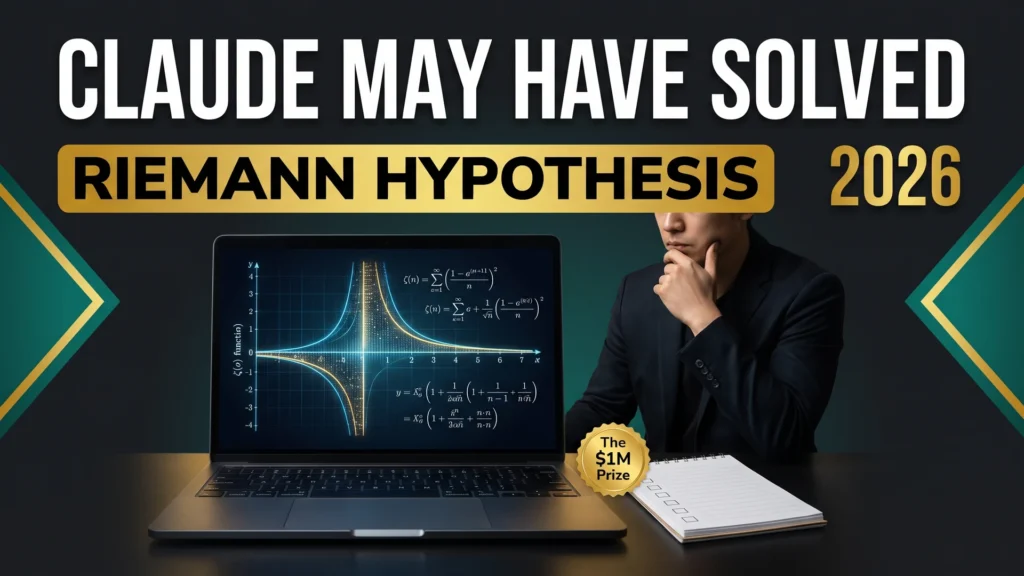
Claude May Have Just Solved the Riemann Hypothesis: What It Means for AI in 2026
Quick note: this article has no affiliate links — nothing to buy here. The links below go straight to the sources I checked. Facts checked 23 November 2026; this story is still moving, and I’ll flag wherever something is disputed rather than settled.
On Friday morning, 20 November 2026, a mathematician at Anthropic posted a four-page note on his personal website and set the maths world on fire. “I believe I have, working with Claude, discovered a proof of the Riemann Hypothesis,” Levent Alpöge wrote. The Riemann Hypothesis. The most famous unsolved problem in mathematics. Open since 1859. Worth a million dollars. And the proof, if it is one, exists only as computer code — about 17 million lines of it — that no human being has actually read.
I’ve spent the weekend reading the announcement, the machine verification, the rival proof that showed up hours later, and the sharp critique that says the whole thing might be empty. Here’s the quick version, then the full story.
Here’s the quick version
- What happened: Anthropic mathematician Levent Alpöge announced on 20 November that he and Claude have proved the Riemann Hypothesis — actually the stronger Generalized Riemann Hypothesis, which would settle RH as a side effect.
- What was verified: On 21 November, the Lean Focused Research Organization and the Mathlib Initiative certified that the proof is correct. All 175,187 modules compile with zero errors, checked by four independent checkers, using only Lean’s three standard axioms.
- What’s disputed: Mathematician J. L. Nielsen published a critique the same day arguing the proof’s key geometric definitions are vacuously true — the machine check passes, but it proves nothing. That dispute is unresolved as of today, 23 November.
- What it doesn’t mean: Nobody has won the $1 million Clay prize (the earliest it could even be considered is late 2028), your encryption is not at risk, and the Claude model used was an unreleased internal research version — not one you can buy or use.
- What it might mean: If the proof holds up, it’s the strongest evidence yet that frontier AI can do frontier research mathematics. If it doesn’t, it’s still the most interesting argument about what “verified” even means that maths has had in years.
What actually happened on Friday
Let me set the scene, because the timing alone tells you how strange this week has been. On Thursday 19 November, Anthropic went public in the largest IPO in history — 980 million shares at $83, raising roughly $81 billion. The next morning, Alpöge posted his note. He’d told Anthropic CEO Dario Amodei beforehand, and he admitted the timing could look cynical. It wasn’t a press release, and Anthropic itself has said nothing about the claim at all. Just a four-page PDF on a personal site, alpo.ge, and a 14-part archive of Lean code.
According to the note, the work ran from 6 October to 16 November — about six weeks. The decisive breakthrough came late on Sunday night, 15 November. And here’s the line that stopped me cold: “Claude and I have had a great time together with such breadth in recent months, but this time Claude far outpaced me near the finish line. No, Claude flew, and danced, and sparkled near that finish line.” Alpöge says he doesn’t yet fully understand or command all of the mathematics in the proof. The human who announced it can’t yet explain all of it. That’s new territory, and it’s worth sitting with for a second.
He also made a practical decision that explains why there’s no paper to read: a written-out version of the proof would run to more than 250,000 pages, so he decided “to only present Lean”, with a proper write-up to follow. No date promised.
This wasn’t completely out of nowhere, either. Back in August 2026, an unreleased Claude research version improved the known lower bound for the fraction of zeta zeros satisfying the Riemann Hypothesis from 41.6% to 67.2% — real, peer-reviewed-adjacent progress published on arXiv. Alpöge had also posted a Claude-generated counterexample to the Jacobian conjecture in July. So the people paying attention knew Claude was doing serious maths. Nobody expected this.
The Riemann Hypothesis, in plain English
Okay, quick detour, because you can’t judge this story without knowing what the problem is. I’ll keep it short.
It’s about prime numbers — 2, 3, 5, 7, 11, and so on. Primes look random, but mathematicians have long suspected they follow a hidden pattern. In 1859, Bernhard Riemann proposed a way to describe that pattern using something called the Riemann zeta function. His hypothesis: every “nontrivial” zero of that function sits on a single vertical line — the critical line — in the complex plane. In plain terms, all the zeros line up exactly where the pattern says they should. No exceptions, ever, out of infinitely many of them.
It’s been open for 167 years. It’s one of the seven Clay Millennium Prize Problems, each worth $1 million, announced in 2000. Only one of the seven has ever been solved — the Poincaré conjecture, by Perelman. Computers have checked the first 10 trillion zeros and they all behave. But checking trillions of cases isn’t a proof, because there are infinitely many zeros, and the next one could always break the pattern. That’s the difference between “we’ve never seen it fail” and “it can’t fail”. A proof is the second thing.
One precision point, because it matters: Alpöge claims the proof covers the Generalized Riemann Hypothesis, GRH, which extends the same claim from the zeta function to a much broader family of functions. GRH implies RH. So the claim is actually the stronger statement — if GRH is proved, RH falls out of it automatically. When I say “the proof” below, I mean the GRH claim and its RH consequence together.
What Claude actually did — and didn’t do
So what did Claude do, exactly? The honest answer is: we know the shape of it, not the details. The approach adapts Stepanov’s method — a polynomial technique originally used to prove the Riemann Hypothesis for curves over finite fields — to the integers, using a chain of “theta lifts” between totally definite unitary groups. Terence Tao, who read the note the same day, said the proof “appears to use the full power of modern developments on the Langlands program and arithmetic geometry”. If that sentence meant nothing to you, join the club — it means the proof leans on some of the deepest machinery in modern maths.
Now the part I need to be very clear about: nobody knows which Claude model did this. The note just says “Claude”. Tao calls it “an internal AI model”. Anthropic has not named the model, and it is an unreleased research version — not Claude Fable 5.2, not Opus 5.5, not Sonnet 5.5, not anything you can open in a browser and ask to solve a maths problem. If you see a headline or a video claiming a specific public Claude model proved the Riemann Hypothesis, that claim is wrong. Don’t repeat it.
And here’s the other thing that makes this story so odd: the proof exists only as Lean code. Lean is a proof assistant — a programming language where every logical step gets checked by computer. A proof that compiles without errors is taken as confirmation that each step follows from the last. The archive is 175,187 Lean files, roughly 17.4 million lines, about 239 MB compressed. The raw proof export unpacks to around 61.6 GB. Nobody has read it. Nobody could read it. That’s not a criticism — it’s the central fact of the story, and everything else follows from it.
The verification — and it genuinely impressed me
Here’s where the story gets strong. On Saturday 21 November at 13:55 UTC, the Lean Focused Research Organization and the Mathlib Initiative issued a joint statement. Their words: “We hereby certify that both the statement and the proof of the Riemann Hypothesis are correct.” And: “We have full confidence that Alpöge’s proof of the Riemann Hypothesis is correct, and we congratulate him on this achievement.”
That wasn’t a casual thumbs-up. The verification ran through four checks adapted from criteria published by the Xena Project. First, the statement proved is Mathlib’s own definition of the Riemann Hypothesis, vetted by experts. Second, the library compiles — dozens of people reproduced the same raw proof export file, with no errors or build failures. Third, two independent tools confirmed the theorem proved is exactly Mathlib’s RH statement, not some lookalike. Fourth, the exported proof was checked by Lean’s official kernel and by independent checkers written in different programming languages, running on an inert export kept out of reach of any hypothetical malicious code in the Lean sources.
The numbers from Andrew Sutherland’s verification page at MIT are worth spelling out, because they’re the strongest part of the whole story. All 175,187 modules compile, zero errors. The five headline theorems depend only on Lean’s three standard axioms — propext, Classical.choice, Quot.sound — with no extra axioms and no “sorry” placeholders anywhere on the path to the conclusion. An independent sandboxed rebuild reproduced the proof export byte for byte. The independent Rust kernel nanoda accepted the full export. So did con-leche, con-ron, and lean4lean, which accepted 175,187 out of 175,187 compiled modules. Two long checks — the Lean default kernel replay and the paranoid kernel replay — were still running as of 22 November, and a proof monitor reportedly recorded the default kernel accepting all five challenge statements early on 23 November, though I haven’t independently confirmed that last one from Sutherland’s page.
Sutherland told Scientific American: “The Lean proof has been compiled and independently rechecked by the Lean kernel with only the three standard axioms. Honestly the chance that anything is fishy here is approximately zero.” That was before the critique below had circulated widely, so hold that thought.
Fields Medalist Ngô Bảo Châu is also reported to have endorsed the proof, saying AI output should be treated as “a part of nature… to scrutinize and theorize”, and that AI will drive further prosperity and “democratization of mathematics”. I should flag this honestly: I could only find that endorsement in secondary reports, not from a primary post by Châu himself. The quote is widely repeated and attributed to a post he shared on social media, but treat it as reported rather than confirmed first-hand.
Now the twist: a mathematician says the proof is empty
This is the part of the story most of the excited coverage skipped, and it’s the reason my title says “may have” instead of “has”. On the very same day, 20 November, mathematician J. L. Nielsen of the Center for Topological Physics in Kansas published a paper on PhilArchive titled “The Invalidity of Alpöge’s Proposed Proof of the Riemann Hypothesis”. Her argument is precise, and it’s devastating if it’s right.
Nielsen’s claim, in her own framing: the construction that supplies the final hypothesis bundle rests on witnesses whose required properties are vacuously true. The geometry predicate in the code is defined as anyGeometry := fun _ _ _ => True — in plain terms, whatever you feed it, it answers “valid”. The geometric witness is built from a model the code itself names degenerate. The height equation — the step that’s supposed to trap a real geometric quantity between two bounds — holds by reflexivity, because the height is defined to be its own formula. Her conclusion: “The proposed proof is invalid: what has been checked is a term whose structural witnesses are vacuously true, not the argument those witnesses stand for.”
Here’s what makes this argument hard to dismiss, and hard to settle quickly. Nielsen concedes the release typechecks against Mathlib’s Riemann Hypothesis. She concedes the kernel and the independent checkers correctly confirm the final term has that type. She concedes there is no hidden axiom and no “sorry” on the path to the conclusion. Her point is different, and it’s about what a machine check can and can’t do. Lean checks whether each step follows from the definitions you wrote down. It cannot judge whether those definitions capture the mathematical content you meant. If a key geometric condition is defined as always true, the machine check passes while proving nothing — the chain compares a quantity with itself and holds by definition.
So both things can be accurately reported at the same time: the code compiles, the final theorem has the right type, and a mathematician argues the intermediate definitions are vacuous, so the chain proves nothing. That’s not a contradiction. It’s the gap between “formally verified” and “mathematically meaningful”, and it’s the most important argument in this whole story.
As of today, 23 November, the dispute is unresolved. I found no published rebuttal or response from Alpöge, the Lean FRO, or Sutherland to Nielsen’s specific points. Her challenge has not become a consensus in the mathematical community, and she acknowledges she has only checked some of the files in a 175,187-file codebase — while the Lean community’s verification mainly targeted the correctness of the formal proof rather than the vacuity question. Nobody has settled it yet. Kevin Buzzard of Imperial College London put the human side of it bluntly: “At the minute, we don’t even know why the theorem is true.” Tao, likewise, says digesting the proof “will take some time” and that “it is very early days”.
One more thing Buzzard said that I think matters: “Much of the press is referring to this as a proof by Claude. I think they should instead credit the person involved: Levent Alpöge… The honour of proving RH, if the proof holds up, belongs largely to him. He should get a Fields Medal for this.” Whatever Claude did, a human mathematician framed the problem, steered the work for six weeks, and staked his name on the announcement. That’s worth remembering while the headlines shout about the machine.
The human rival who lost the race by hours
The strangest subplot of the week arrived hours after Alpöge’s announcement. Ravi Vakil, a Stanford mathematician, posted a “hurried announcement” of a rival proof — a 940-page human-written manuscript called “The Music of the Primes” by Alessandro Masullo, a Stanford postdoc who had worked on it for about 12 years. All human, no AI, Vakil stressed. The plan had been to spend a year polishing it with Brian Conrad, who had been examining the draft closely for months. Then Alpöge’s announcement landed, and Vakil decided to release the draft as it stood.
About eight hours later, Vakil updated the same post: several people had reported problems in the proposed proof — found with the help of different AI models. He made “no claim as to the correctness of the proof strategy” and said every issue would have to be resolved to the community’s satisfaction before the proof could be accepted. Conrad later told Scientific American the paper is “undergoing major revision”. Masullo himself said it “was not ready for publication”, set up a website noting the draft “was never meant to be seen by the public in its current state”, and said revisions would come “in the forthcoming months”. Independent readers have published gap notes since — uniform-boundedness failures, placeholder theorems in Chapter 13 — though I haven’t verified those errata first-hand, so I’m reporting them as reported, not as settled fact.
I want to be careful here, because it’s easy to tell this as a story with a winner and a loser, and that’s not fair. Masullo’s draft having reported problems does not disprove GRH, and it doesn’t prove Alpöge’s claim either. The two attempts are independent, and they’re in very different states: one is machine-checked code with institutional certification and an open dispute about its definitions; the other is a readable human draft already collecting errata. The contrast is the point. For the first time, we can compare a machine-checked proof no human understands with a human-written proof humans can actually read — and right now, neither one is accepted.
What this does NOT mean
Three things you will hear this week that aren’t true. Let me knock them down in order.
Nobody has won the $1 million. The Riemann Hypothesis is still listed as unsolved on the Clay Mathematics Institute’s website. Clay’s rules, revised in 2018, are strict: it doesn’t accept direct submissions, the solution must be published in a refereed journal of worldwide repute, at least two years must pass after that publication, and the solution must have general acceptance in the global maths community. Only then can a committee even be formed. Alpöge’s proof has so far appeared only as Lean code on a personal website — not a qualifying publication — so the two-year clock hasn’t even started. On the fastest possible path, a prize couldn’t be considered before late 2028. If anyone tells you Claude won a million dollars, they’re wrong.
Your encryption is not at risk. I’ve seen this one floating around, and it’s nonsense. A proof of the Riemann Hypothesis would not break RSA, elliptic-curve cryptography, or Bitcoin. RSA’s security rests on factoring being hard, and a proof of RH hands nobody a factoring algorithm. Determining whether a number is prime is not the same as finding its factors. The real long-term threat to today’s encryption is a large quantum computer, not a theorem about prime numbers. What a GRH proof would do in maths is confirm hundreds of theorems that mathematicians have proved assuming RH or GRH is true — Scientific American put it well, saying it would “cascade through all of math, in a flash revealing that many of the elaborate interlocking assumptions built on its presumed bedrock veracity are, in fact, true”. That’s enormous for mathematics and irrelevant to your passwords.
You can’t use the Claude that did this. Anthropic announced no model, no plan, and no price change in connection with the claim. Its most capable public model is still Claude Fable 5.2. The model behind the proof was an internal research version, and Anthropic hasn’t even commented on the announcement. So if a tool or a course pops up this week promising to teach you “the Claude that solved the Riemann Hypothesis”, that’s someone selling you a story, not a product.
What it DOES mean — for AI, and for maths
So if the prize isn’t won, the encryption isn’t broken, and you can’t buy the model — why does this matter? Because of what it says about where AI is going, and because of what it says about proof itself.
If the proof holds up — and that’s still an “if”, given the Nielsen dispute — it would be the strongest evidence yet that frontier AI can do frontier research mathematics, not just homework problems. This wasn’t a benchmark or a puzzle with a known answer. It was a 167-year-old open problem at the top of the field, attacked with the full machinery of the Langlands program, and the machine didn’t just help — by Alpöge’s own account, it outpaced him near the finish line. Abhishek Saha of Queen Mary University of London called the Riemann Hypothesis “the most famous and important unsolved problem in mathematics”. Solving it, or even coming this close, with an AI as a collaborator, changes what mathematicians think is possible. Youness Lamzouri put it plainly: the new claim, “if correct, would establish that every one of them follows the pattern, without exception”.
And if the proof doesn’t hold up — if Nielsen is right and the definitions are vacuous — it still matters, in a different way. It would be the first great test case for a new kind of failure: a proof that is formally perfect and mathematically empty, certified by machines and caught by a human reading the definitions. That would force the maths world to rethink what verification means when the proofs are too big for any human to read. Either way, something important just happened. The only wrong reaction is pretending the story is already settled.
There’s also a quieter shift underneath all of this. Châu’s reported line — that we should treat AI output as “a part of nature… to scrutinize and theorize” — captures a future where mathematicians spend less time building long proof chains and more time asking good questions and checking what the machine produces. Meta’s chief AI officer, Alexandr Wang, published an essay on 23 November reading the formalization as evidence that superintelligence is arriving. That’s his opinion, not a verification, and I’d treat it as such. But the direction of travel is hard to miss: the bottleneck in maths is moving from “can we prove it” toward “can we understand what was proved”.
For my own corner of the world — AI tools, and what they’re actually good for — the lesson is refreshingly concrete. Claude’s public models are already strong coding and writing assistants; if you’re curious what the current public Claude can do for your own work, my Claude Code 2.1 Auto Mode breakdown covers the version you can actually use today, including its fail-closed safety rules. And if you want a sense of how fast the frontier is moving across the board, the Mistral Pixtral Large 2502 pricing guide shows how quickly new models are arriving and undercutting each other. Neither of those models solved the Riemann Hypothesis. That’s the point — the model that might have is one you can’t touch yet.
My verdict
Here’s where I land, after a weekend with the sources. The machine verification is real, and it’s impressive: 175,187 modules, zero errors, four independent checkers, three standard axioms, a byte-for-byte rebuild. That deserves respect. The Nielsen critique is also real, and it’s specific: definitions that return “true” by construction, a height that equals its own formula, a chain that may compare a quantity with itself. That deserves an answer, and as of today, it doesn’t have one.
So no, I’m not calling the Riemann Hypothesis solved. The honest headline is: claimed, machine-certified, and seriously challenged — verdict still open. What I am confident saying is that this week changed the conversation. A human mathematician and an AI spent six weeks on the hardest problem in maths and produced something no human can read, that machines certify, and that another human says is empty. Whichever side wins that argument, the way mathematics gets done just shifted under our feet. I’ll be watching for Alpöge’s response to the critique, and for the human-readable write-up he promised. When either one lands, I’ll update this article and say so plainly.
Facts checked 23 November 2026. If the Nielsen dispute gets a response, or the Clay Institute changes the problem’s status, this article will be updated — check the sources below for the latest.
Sources
- Levent Alpöge, “Remark on the Riemann Hypothesis” (announcement note, 20 Nov 2026) — alpo.ge/remark.pdf
- Lean FRO + Mathlib Initiative, “Lean verification of the Riemann Hypothesis” (joint statement, 21 Nov 2026) — leanprover-community.github.io/blog/
- Andrew Sutherland, verification page (MIT) — math.mit.edu/~drew/grh/
- Terence Tao, “Unforced Euler singularity, unforced Navier–Stokes singularity, and the generalized Riemann hypothesis” (20 Nov 2026) — terrytao.wordpress.com
- Scientific American, “The AI Riemann hypothesis proof is true, independent mathematicians confirm” — scientificamerican.com
- Scientific American, “What the Riemann hypothesis proof really means about AI and the future” — scientificamerican.com
- J. L. Nielsen, “The Invalidity of Alpöge’s Proposed Proof of the Riemann Hypothesis” (PhilArchive, 20 Nov 2026) — philarchive.org/rec/NIEIOT-2
- Clay Mathematics Institute, Millennium Prize rules — claymath.org/millennium-problems/rules/ and the Riemann Hypothesis problem page — claymath.org/millennium/riemann-hypothesis/
- Anthropic, “Learning more about Claude’s mathematical capabilities” (Aug 2026 zeta-zero result) — anthropic.com/research/riemann-zeta
- Al Jazeera, “Riemann hypothesis: has the world’s most famous maths problem been cracked” (21 Nov 2026) — aljazeera.com
- CNN, “Anthropic mathematician claims AI helped solve the Riemann hypothesis” (21 Nov 2026) — cnn.com