Gemini 4 Carbon Pricing in 2026: Google’s Strongest AI Model, Real Price, and the November 30 Deadline
Disclosure: there are no affiliate links in this article. Google runs no affiliate program for Gemini 4 Carbon, the Gemini API, or Google AI Ultra, so Affitrove earns nothing if you sign up for anything below. Every vendor link here is a plain link, and I have nothing to gain by ranking one model above another. Prices checked 19 November 2026.
I’ve been watching Google’s Gemini releases for two years now, and I have to tell you — the last three weeks have been the wildest stretch yet. A brand-new frontier model lands on 28 October, tops the independent benchmark charts, and then gets overtaken twice before most people even hear its name. Meanwhile its launch price is quietly set to double on 30 November, which happens to be Cyber Monday. If you use AI models through an API, or you’re thinking about it, that date matters more than any Black Friday deal this year — because there isn’t one. Not from Google, not from OpenAI, not from Anthropic. The intro price is the deal, and it’s about to end.
So here’s the straight story on Gemini 4 Carbon: what it actually is, what it really costs, what the benchmarks say once you separate Google’s claims from independent tests, and whether you should bother with it at all. Because the honest answer is more complicated than the headlines — and Google itself will tell you that for most jobs, Carbon isn’t the model you want.
The short version
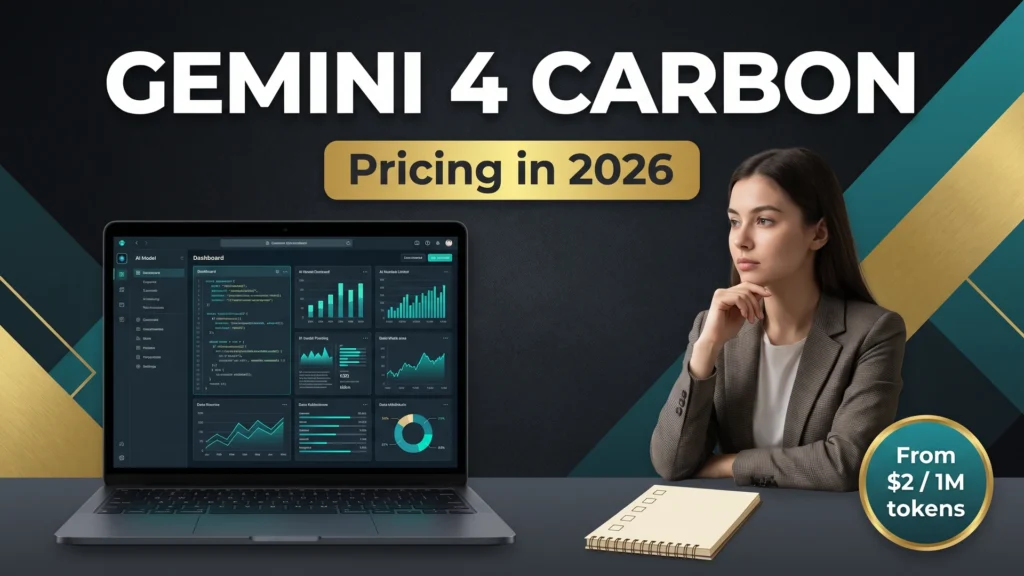
Gemini 4 Carbon is real. It’s Google’s deepest-reasoning model, announced 28 October 2026 and generally available since 10 November 2026. Through the API it costs $2 per million input tokens and $10 per million output tokens — but only until 30 November. From 1 December that doubles to $4 and $20, which is exactly what Claude Opus 5.5 already charges. There’s no free tier, and thinking tokens are billed as output, so heavy reasoning jobs cost more than the headline rate suggests.
In the Gemini app, Carbon is locked behind Google AI Ultra — the $99.99 or $199.99 a month tier, depending on which version of Google’s restructured pricing you land on. Google AI Pro at $19.99 a month gets you Argon, not Carbon. If that sounds steep, that’s because it is: Carbon is a specialist tool for the hardest jobs — long-horizon coding, deep research, defensive cybersecurity — and Google says Argon is still the better default for most software engineering and knowledge work. Hydrogen, launched 12 November, is the fast everyday model, and it even has a free tier.
On benchmarks, Carbon topped the Artificial Analysis Intelligence Index at launch with a score of 59. Two weeks later it had slipped to around fourth: Claude Fable 5.2 (released 9 November) scores 65, GPT-6.2 Astra (released around 17–18 November) scores 62, and Carbon sits at 60. Still excellent — just not number one anymore. And the flashiest security numbers you’ve seen quoted for Carbon belong to a locked, allowlisted cyber variant that you and I can’t access. I’ll explain that properly below, because it’s the one thing most coverage gets wrong.
What Gemini 4 Carbon actually is
Carbon is the second model in the Gemini 4 family, after Argon. The family uses element names — Argon, Carbon, Hydrogen — and each one has a distinct job. Argon is the efficient frontier model: the all-rounder. Hydrogen is the fast, everyday workhorse. Carbon is the deep thinker. Google built it for jobs that take a long time and a lot of reasoning: multi-step coding and debugging across a huge codebase, agentic workflows that run for hours, high-precision knowledge work like legal and financial documents, scientific reasoning, and defensive cybersecurity.
The key design choice is that Carbon uses more tokens than Argon to get to an answer. It explores more thoroughly, reasons more deeply, and runs extended verification loops before it replies. That’s a feature, not a bug — but it has a direct cost consequence. At the same per-token price, a Carbon job can easily cost more than an Argon job, because Carbon burns more tokens per task. Keep that in mind every time you see a per-token price comparison in this article. Price per token is not price per job.
Technically, the model ID is gemini-4-carbon. Its knowledge cutoff is March 2026. It takes text, images, audio, and video as input and produces text. It supports three thinking levels — LOW, MEDIUM (the default), and HIGH — so you can dial the reasoning effort up or down depending on the job. Temperature, top-p, and top-k are fixed; custom values are ignored, so you don’t get the usual sampling knobs. It works with Google Search, Maps, and Agent Search grounding, code execution, function calling, URL context, computer use, and structured output. You can feed it PDFs, plain text, and Office files. And it runs through the standard GenerateContent API, the Interactions API, and an OpenAI-compatible Chat Completions endpoint — but not the Gemini Live API, which Carbon doesn’t support.
One more thing worth knowing: Carbon arrived alongside a new feature in Google’s Antigravity coding environment called /swarm, currently in preview. One prompt becomes a coordinated team of agents, and Carbon gets assigned the deepest-reasoning roles in that team. That tells you exactly how Google sees this model — not as your daily driver, but as the heavy lifter you call in for the hardest part of a job.
The release timeline: a two-stage launch
Carbon didn’t just appear one morning. Google rolled it out in two stages, and the staging matters because it explains some of the confusion in early coverage.
28 October 2026 — announcement, Fairwind only. Koray Kavukcuoglu, Google DeepMind’s SVP and Chief AI Architect, announced Carbon on the Google blog. At first, access was limited to cybersecurity defenders through Google’s Fairwind Program — the same route Argon took a month earlier (announced 30 September, generally available 13 October). Fairwind is Google’s program for getting frontier models into the hands of defenders before attackers, and it’s the reason Carbon’s earliest press was all about security.
10 November 2026 — generally available. Carbon opened up to paying customers through the Gemini API, Gemini for business, and Google AI Ultra — in the Gemini app, AI Mode in Search, and Antigravity. That’s nine days before I’m writing this, which is why there are no user-review aggregator scores yet and why the benchmark picture is still moving fast.
12 November 2026 — Hydrogen joins the family. Two days after Carbon went GA, Google launched Gemini 4 Hydrogen, the fast everyday model. It replaced Gemini 3.8 Flash as the default workhorse, and — unlike Carbon and Argon — it has a free tier. Antigravity’s Orchestrator can now auto-switch between Hydrogen and Carbon, which Google claims cuts quota use by 24% and speeds things up by 19%. Take those percentages as vendor claims, but the direction is sensible: use the cheap fast model by default, escalate to Carbon only when the task genuinely needs it.
For context, the line runs: Gemini 3 in November 2025, Gemini 3.1 Pro in February 2026, the 3.5–3.8 Flash models through mid-2026, then Gemini 4 — Argon in October, Carbon in November, Hydrogen days later. Google is shipping frontier models at a pace that makes any “best model” ranking go stale within a fortnight. That’s not a complaint, just a warning about every benchmark number in this article: they’re accurate as of 19 November 2026, and they will move.
What it can do: the specs that actually matter
Most model announcements bury you in numbers. Here’s the short list of Carbon’s specs that change how you’d actually use it.
A unified 1-million-token context window. Carbon’s context is 1,048,576 tokens — but the important word is unified. Input, thinking, function calls, and the final response all share one 1M-token budget. Earlier Gemini models kept input and output budgets separate; Carbon doesn’t. That means a huge reasoning job eats into the same pool as your documents. If you feed it a 600,000-token codebase and ask it to think hard, it has 400,000 tokens left for thinking and answering combined. For most jobs that’s plenty. For the very biggest jobs, it’s a real constraint you need to plan around. Maximum output runs up to 1M tokens through long decodes, though a single streaming segment tops out at 65,536 tokens.
Thinking levels instead of a thinking budget. You pick LOW, MEDIUM, or HIGH. That’s it — there’s no fine-grained token budget control, and the MINIMAL level returns an error. For a quick classification or a short summary, LOW keeps costs down. For the multi-hour debugging job Carbon was built for, HIGH is the point. The catch, again: thinking tokens are billed as output, at the full output rate. A HIGH-thinking run on a hard problem can easily spend several times more on thinking than on the final answer. When you see the worked examples in the pricing section, remember that the thinking is where the money goes.
Office files and long documents. Carbon accepts PDF, plain text, and Office formats — .docx, .pptx, .xlsx — plus OpenDocument files. Combined with the 1M context, that’s the enterprise knowledge-work pitch: drop in a whole contract set or a quarter’s worth of financial filings and ask it to reason across them. Google’s own examples lean on this heavily — deep financial research, where Carbon matched the best model tested on Hebbia’s end-to-end financial agentic evaluation and ranked top of 23 frontier configurations on Balyasny’s General Financial Intelligence benchmark. Vendor-selected benchmarks, obviously, but the use case is coherent.
Grounding, tools, and caching quirks. Carbon supports grounding with Google Search and Maps, code execution, function calling, URL context, and computer use. Two things to know: explicit context caching is not supported — only implicit caching, with a 4,096-token minimum — and grounding with Google Search gives you 5,000 free requests a month (shared across Gemini 3 and newer models), then $14 per 1,000 requests with a daily cap of 1,500. If you’re building an agent that grounds every step in live search, that $14 per thousand adds up fast.
Where it runs. Regions are global, US, and EU. You can buy it pay-as-you-go (Standard and Priority tiers), as Batch, as Flex, on a Deferred tier, or as Provisioned Throughput if you need guaranteed capacity. No free tier anywhere — Carbon is a paid-only model from day one.
The cybersecurity story — and the honest caveat
This is the section where most coverage of Carbon goes wrong, so let me be blunt about it.
You may have seen spectacular numbers attached to Carbon’s name: 88.2% on SEC-bench Pro, 54.8% on ExploitGym, 71.0% on CWE-bench. Those are real scores. They are not scores for the model you can buy.
They belong to Gemini 4 Carbon for cyber — model ID gemini-4-carbon-cyber-permissive — a separate variant tuned for defensive cybersecurity work: vulnerability discovery, reverse engineering, exploit verification, patch generation. It’s allowlisted only, through the Fairwind Program, for enterprise customers in select regions. Access to earlier cyber models does not carry over; you have to apply separately. And the headline benchmark runs were done without out-of-model guardrails. So when a blog tells you “Carbon scores 88% on security benchmarks,” it’s quoting a locked variant’s unguarded results as if they were the public model’s. They’re not.
What can I say about the public model’s security posture? Google published safety numbers for Carbon itself, and they’re genuinely impressive: it blocked 99% of attack trajectories in simulated cyberattack testing, with a per-attempt breach rate of 0.8% versus 3.1% for Argon. On Gray Swan’s automated cyberattack tests it succeeded only 2.17% of the time versus 9.86% for Argon. It scored 0% prompt-injection attack success on Gray Swan’s IPI benchmark — the first time any model has reached zero there. Trajectory Labs found zero new universal jailbreaks in 132 hours and over 13,000 requests. And on an agentic honesty benchmark it passed 92% of the time versus 70% for Argon.
Read that carefully: these numbers describe how hard Carbon is to attack, not how good it is at attacking. That’s the right way to think about a frontier model in late 2026. The cyber variant’s offensive numbers are interesting, but they’re not your numbers unless you’re inside the Fairwind Program. Google also ran an internal “Project Fortify” benchmark — 100% recall on scanning, 95% precision on triage — and cites a Wiz “Scan for Good” exercise where Carbon found zero-day vulnerabilities in two major SaaS providers in under two hours. Internal benchmarks and partner exercises are vendor claims, not independent verification, but they line up with the direction of the independent data: this is a careful, hard-to-fool model.
One more access note: Google opened applications for 10,000 scientists to get Argon free for six months in Antigravity, and Carbon access has now been extended to current and future participants in that program, with rolling onboarding. If you’re a working scientist, that’s the one legitimate free route to Carbon that exists.
Benchmarks: Google’s claims vs the independent scoreboard
Here’s where the story gets fun — and where you need dates attached to every claim, because the leaderboard moved twice in two weeks.
At launch, Carbon was number one. On 28–30 October 2026 it topped the Artificial Analysis Intelligence Index v5.0 with a score of 59, ahead of Claude Opus 5.5 at 58 and GPT-6 Astra at 57. Google’s own announcement claimed first place on CursorBench 4.0, Perplexity’s WANDR, and Zapier’s AutomationBench, at more than twice lower cost per task than the next best external model, plus second place on the new Multimodal Knowledge Agent benchmark at more than six times lower average cost per task than the top model. All vendor-reported, all worth noting, none independently verified at the time.
By mid-November, it had slipped to around fourth. Anthropic released Claude Fable 5.2 on 9 November, and it scores 65 on the same index. OpenAI’s GPT-6.2 Astra, released around 17–18 November, scores 62. Carbon sits at 60, Opus 5.5 at 59. So the honest sentence is: Carbon topped the index at launch on 28 October, and was overtaken within two weeks. Any article still calling it “the #1 AI model” without a date is out of date.
The per-benchmark picture is more nuanced than the headline index, and it’s mostly good news for Carbon:
- Terminal-Bench 4.0 — 65.2%. The best score of the five frontier models compared, ahead of Fable 5.2 and Opus 5.5 (both 59.6%), GPT-6 Astra (59.1%), and Argon (57.1%). If you write code in a terminal, this is the number that matters most.
- AutomationBench-AA — 77.8%. Strong on agentic automation tasks, consistent with Google’s launch claims.
- HLE-Diamond — 69.1%. Respectable, but Fable 5.2 leads here at 80.2%. On the hardest general-knowledge questions, Claude’s newest model is clearly ahead.
- FrontierCode 2.0 — 40.6%. Again behind Fable 5.2 (48.8%). Carbon is a strong coder, not the best coder, on the hardest coding tests.
- AA-Omniscience (hallucination rate) — 11.4%. This is Carbon’s quiet superpower. Fable 5.2 hallucinates 59.3% of the time on this test, Opus 5.5 50.3%, GPT-6 Astra 49.8%. Carbon is wrong far less often than any of its rivals — though interestingly, Argon is better still at 4.3%. If accuracy matters more than raw capability, Carbon is the safest frontier bet that isn’t Argon.
- Coding Agent Index — 59, behind Claude Code paired with Opus 5.5 at 62.
- Cost per Intelligence Index task — $7.76, roughly 23% cheaper than Opus 5.5. That’s the per-task cost story in one number: cheaper per token and cheaper per completed task than its nearest rival, even after the crown slipped.
So what’s the fair summary? Carbon is the best terminal coder of the group, the least hallucination-prone frontier model except its own sibling Argon, and the cheapest per completed task. It’s not the best at the hardest general reasoning or the hardest coding benchmarks — Fable 5.2 took those. And its launch-week “#1” was real, brief, and already history. If you’re choosing a model today, you’re choosing between Carbon’s accuracy and value, Fable’s raw capability, and GPT-6.2 Astra’s balance — not between a champion and the rest.
Gemini 4 Carbon pricing in 2026
Here’s the full rate card, read from Google’s official Gemini API pricing page on 19 November 2026. Every price is per million tokens.
| Tier | Input / 1M | Output / 1M (incl. thinking) | Cached input / 1M |
|---|---|---|---|
| Standard — through 30 Nov 2026 | $2.00 | $10.00 | $0.10 |
| Standard — from 1 Dec 2026 | $4.00 | $20.00 | $0.20 |
| Batch (50% off) — through 30 Nov | $1.00 | $5.00 | $0.05 |
| Batch — from 1 Dec | $2.00 | $10.00 | $0.10 |
| Flex — through 30 Nov | $1.00 | $5.00 | $0.05 |
| Flex — from 1 Dec | $2.00 | $10.00 | $0.10 |
| Priority — through 30 Nov | $3.60 | $18.00 | $0.18 |
| Priority — from 1 Dec | $7.20 | $36.00 | $0.36 |
Three things jump out. First, the intro price ends on 30 November 2026 and the price doubles the next day — $2/$10 becomes $4/$20, and the same doubling applies to Batch, Flex, and Priority. Argon has the identical rate card and the identical deadline, so this is a family-wide launch price, not a Carbon-only offer. Second, there’s no free tier at all — not even a small one. Third, the Batch and Flex tiers at half price are the real bargain for anyone who can wait: batch work at $1/$5 through November, or $2/$10 from December, which is the same as Carbon’s standard intro price.
Let me make this concrete with a worked example. Say you send a 200,000-token input — roughly a large codebase chunk or a stack of documents — and get a 20,000-token response back. At intro rates that’s about $0.60. From 1 December, the same call costs about $1.20. Now add thinking: if Carbon spends another 40,000 tokens reasoning at HIGH thinking level before answering, that’s 40,000 more output tokens — $0.40 at intro rates, $0.80 from December — and your $0.60 job is suddenly $1.00, or $2.00 after the deadline. That’s the math that matters. The thinking is the expensive part, and Carbon thinks more than Argon does.
At volume, the numbers scale fast. A team running a million input tokens and half a million output tokens a day pays roughly $7 a day at intro rates ($2 + $5) and $14 a day from December ($4 + $10). Over a month, that’s about $210 versus $420. Not ruinous for a business, but the doubling is real money, and it’s worth deciding before 30 November whether Carbon is actually the model you need — or whether Argon at the same rate card, or Hydrogen at $1.50/$7.50, does the job for less. Note also that Batch pricing from 1 December ($2/$10) equals today’s standard intro price, so if your work can be batched and deferred, the deadline barely bites.
How to actually use it
There are four realistic routes to Carbon, and they suit very different people.
1. The Gemini API / AI Studio (developers). This is the main route. Carbon is available through the paid Gemini API — model ID gemini-4-carbon — and in AI Studio for testing. You pay per token on the rate card above, no free tier, and you need a billing-enabled project. If you’re building agents or coding tools, this is where you start. The OpenAI-compatible Chat Completions endpoint makes it a near drop-in replacement in existing tooling, which is a quiet advantage: swapping a model string is easier than rewriting your stack.
2. The Gemini app with Google AI Ultra (consumers). If you just want to chat with Carbon in the Gemini app, or use it in AI Mode in Search, you need Google AI Ultra. Google AI Pro at $19.99 a month gets you Argon — not Carbon. And here’s where I have to flag a conflict: Google’s Ultra price is reported differently in different places. The May 2025 launch price was $249.99 a month. Multiple November 2026 sources that read Google’s plans page directly report a restructured Ultra at $99.99 a month (five times the AI Pro usage) or $199.99 a month (twenty times the usage), monthly billing only. I’m going with the November figures, because they’re the ones that match what Google’s own plans page showed this month — but check Google’s plans page yourself before you pay, because this one clearly moved during 2026. Google AI Plus sits below Pro at $4.99 a month. Students, by the way, can still get Google AI Pro free for a year — a standing offer, not a Black Friday deal.
3. Antigravity (developers who code in Google’s IDE). Carbon is available in Antigravity, Google’s agentic coding environment, for Ultra subscribers — and it’s the model behind the heavy-lifting roles in the new /swarm preview. If you already live in Antigravity, this is the most natural way to meet Carbon: the Orchestrator hands it the hardest subtasks and keeps Hydrogen on the routine ones.
4. The scientists program (researchers). Google opened applications for 10,000 scientists to get Argon free for six months in Antigravity, and Carbon access has been extended to participants. It’s eligibility-gated and onboarding is rolling, but if you’re a working scientist, it’s the only free Carbon access that exists.
What you can’t do: there’s no way to try Carbon free as a general user, no free tier on the API, and no Pro-subscription route in the app. If a site tells you otherwise, it’s wrong or it’s talking about Hydrogen.
Carbon vs Argon vs Hydrogen: which Gemini 4 model for which job
Google now sells three frontier models that overlap heavily, so here’s the honest comparison — all prices verified November 2026.
| Model | Role | API price (in/out per 1M) | Context | Free tier? | In the app |
|---|---|---|---|---|---|
| Gemini 4 Carbon | Deepest reasoning, cyber, long-horizon work | $2/$10, then $4/$20 from 1 Dec | 1M unified | No | AI Ultra only |
| Gemini 4 Argon | Efficient frontier, most coding and knowledge work | $2/$10, then $4/$20 from 1 Dec | 1M unified | No | AI Pro + Ultra |
| Gemini 4 Hydrogen | Fast everyday coding and agents | $1.50/$7.50 flat | 1M | Yes (rate-limited) | All tiers, incl. free users |
Argon and Carbon cost exactly the same, token for token, and both double on 1 December. The difference is what you get for the money. Argon is the efficient one — Google’s own words are that Argon “remains the right choice for most software engineering and knowledge work.” It’s also the less hallucination-prone of the two: 4.3% on the AA-Omniscience test versus Carbon’s 11.4%. Carbon is the one you reach for when Argon isn’t enough: the gnarliest debugging session, the multi-hour agent run, the research problem where you want the model to verify its own work repeatedly. You pay for that depth in tokens, not in rate — Carbon simply uses more of them per job.
Hydrogen is the interesting one. Launched 12 November as the successor to Gemini 3.8 Flash, it’s roughly 2.5 times faster than 3.8 Flash, it beats Argon on the Artificial Analysis Intelligence Index at default high thinking (51 versus 50, and 54 at extra-high thinking), and it costs $1.50/$7.50 flat — with no December price rise mentioned anywhere. Plus it has a free tier, and it’s available to free users in the Gemini app on auto-select. For everyday coding and agent work, Hydrogen is now the obvious default, and Antigravity’s Orchestrator will increasingly make that choice for you.
My rule of thumb: Hydrogen for the daily work, Argon for the serious work, Carbon for the hardest work. If you can’t tell which category your job falls into, it’s not a Carbon job.
Carbon vs the rivals
Carbon doesn’t compete in a vacuum. Here’s the November 2026 frontier price board, standard API tier, per million tokens — and then the part the price board doesn’t tell you.
| Model | Vendor | Input | Output | Context |
|---|---|---|---|---|
| Gemini 4 Carbon (to 30 Nov) | $2.00 | $10.00 | 1M | |
| Gemini 4 Carbon (from 1 Dec) | $4.00 | $20.00 | 1M | |
| Claude Opus 5.5 | Anthropic | $4.00 | $20.00 | 1M |
| Claude Sonnet 5.5 | Anthropic | $2.00 | $10.00 | 1M |
| Claude Haiku 5.5 | Anthropic | $0.10 | $0.50 | 1M |
| Claude Fable 5.2 | Anthropic | $8.00 | $40.00 | 1M |
| GPT-6 Astra | OpenAI | $10.00 | $50.00 | 1.05M |
| GPT-6.1 Sol | OpenAI | $2.00 | $10.00 | 1.05M |
| GPT-6.1 Terra | OpenAI | $1.00 | $5.00 | 1.05M |
| GPT-6 Luna | OpenAI | $0.10 | $0.50 | — |
| GPT-6.2 Astra | OpenAI | $8.00 | $40.00 | — |
| Grok 4.7 | xAI | $2.00 | $6.00 | 500K |
Through 30 November, Carbon is the cheapest frontier model per token — tied with Argon and Claude Sonnet 5.5, half the price of Opus 5.5, a quarter of Fable 5.2, and a fifth of GPT-6 Astra. From 1 December it matches Opus 5.5 exactly, dollar for dollar. That’s the price story in one paragraph, and it’s the reason the deadline matters.
But the price board isn’t the whole story, and the three cheapest-looking options have catches worth knowing. Grok 4.7 looks like the bargain of the table at $2/$6 — until you read the fine print: rates double to $4/$12 for any request with a prompt of 200,000 tokens or more, and the US endpoint carries a 10% surcharge. If your whole pitch is “long context, cheap price,” a 200K-token threshold is exactly where it stops being cheap. GPT-6.2 Astra, released around 17–18 November, is 20% cheaper than GPT-6 Astra at $8/$40 and already sits second on the Intelligence Index at 62 — and OpenAI says it’s the first model to hit its internal “High” self-improvement threshold, which is OpenAI’s own classification and should be read as such. Claude Fable 5.2, released 9 November at $8/$40, is 20% cheaper than Fable 5.1 and currently the top-scoring model on the independent index at 65 — but it hallucinates far more than Carbon does, and at twice Carbon’s December price, every one of those hallucinated tokens costs double.
The honest comparison is cost per completed task, not cost per token. Independent testing puts Carbon at $7.76 per Intelligence Index task — about 23% cheaper than Opus 5.5. But Carbon also burns more thinking tokens per job than Argon, so two models with the same rate card can produce very different bills. If your workload is mostly short, well-defined tasks, Sonnet 5.5 or GPT-6.1 Sol at $2/$10 — or Hydrogen at $1.50/$7.50 — will almost certainly be cheaper in practice than Carbon at any price. Carbon earns its keep on the jobs where a cheaper model fails and you have to run it twice, or where a wrong answer costs more than the tokens did. That’s a smaller set of jobs than the marketing suggests.
One more comparison worth making, for the subscription crowd: ChatGPT Plus is $20 a month and ChatGPT Pro is $200; Claude Pro is $20 and Max runs $100 or $200; Google AI Pro is $19.99 a month. None of those subscriptions buy you Carbon — only Ultra does. So if you’re a consumer weighing subscriptions, Carbon isn’t really in the comparison at all. It’s an API and Ultra-tier product, and its competition is other API models, not other chat apps.
For the tooling around all of this — connecting models to your actual apps and data — my guide to the 7 best MCP servers in 2026 covers the servers that make an AI model useful beyond its own chat window. And if you’re comparing Google’s AI pricing more broadly, my Gemini TTS pricing guide and Google Veo 3 pricing guide use the same check-everything-twice approach.
Black Friday 2026: there is no deal — the intro price is the deal
Let me save you some searching. As of 19 November 2026, no Black Friday or Cyber Monday offer has been announced by Google, OpenAI, Anthropic, xAI, or Perplexity. No discount percentages, no promo codes, no bundle deals. Google has no record of ever discounting Gemini plans for Black Friday — its Black Friday posts are about shopping features, not model pricing. If you see a site advertising a “Gemini 4 Carbon Black Friday code,” it’s inventing one.
What does exist is a deadline that happens to land on Cyber Monday itself. Black Friday 2026 is 27 November. Cyber Monday is 30 November. Carbon’s introductory API pricing ends 30 November. That’s not a sale — it’s a launch price expiring on the biggest shopping day of the year, which is either a coincidence or a very deliberate piece of scheduling. Either way, the practical effect is the same: if you want Carbon at $2/$10, you have until the end of 30 November. After that it’s $4/$20, and the Batch tier at $2/$10 becomes your cheapest route.
For completeness: last season’s precedent was Google offering AI Pro annual at 50% off — $99.99 for the first year instead of $199.99 — starting 23 December 2025, for new subscribers only. That was not a Black Friday deal, it was a post-Christmas offer, and nothing like it has been announced for 2026. Don’t plan around it returning. And the one standing discount that is real: Google AI Pro free for one year for students. That gets you Argon, not Carbon — but for a student, Argon at $0 is a better deal than Carbon at any price.
My verdict: who should use it, and who shouldn’t
After all that, here’s where I land.
Use Carbon if you’re doing long-horizon agentic work, debugging across a large codebase, running deep research where a wrong answer is expensive, or doing defensive security work with access to the Fairwind Program. Use it if you’re building agents in Antigravity and want the strongest reasoning available for the hardest subtasks. And if you’re going to use it, start before 30 November — not because of hype, but because the price literally doubles and there’s no reason to pay double for the same tokens.
Don’t use Carbon if your work is everyday coding, drafting, summarising, or chatting. Hydrogen is faster, cheaper, has a free tier, and beats Argon on the index at high thinking. Argon is Google’s own recommended default, hallucinates less, and costs exactly the same per token. Sonnet 5.5 and GPT-6.1 Sol match Carbon’s intro price with broader tooling ecosystems. For most people, most of the time, one of those four is the right call — and the money you save buys a lot of tokens.
The one-line version: Carbon is Google’s strongest model, genuinely cheap until 30 November, and not the best buy for most people — which is exactly what Google says too. The strongest model and the best buy are different things, and this month more than most, it’s worth knowing which one you’re actually buying.
Frequently asked questions
Is Gemini 4 Carbon free?
No. There is no free tier for Carbon on the API, and no free route in the Gemini app. The only free access is the scientists program — 10,000 scientists getting Argon free for six months in Antigravity, with Carbon access extended to participants. Everyone else pays per token, or pays for Google AI Ultra.
How do I access Gemini 4 Carbon?
Through the paid Gemini API (model ID gemini-4-carbon) or AI Studio, through Gemini for business, or in the Gemini app, AI Mode in Search, and Antigravity with a Google AI Ultra subscription. Google AI Pro does not include Carbon.
What happens to the price on 1 December 2026?
The standard rate doubles from $2 input / $10 output per million tokens to $4 / $20. Cached input doubles from $0.10 to $0.20. Batch and Flex double from $1/$5 to $2/$10, and Priority doubles from $3.60/$18 to $7.20/$36. Argon’s price doubles on the same day.
Is Gemini 4 Carbon the best AI model right now?
It was, briefly. It topped the Artificial Analysis Intelligence Index at launch on 28 October 2026 with a score of 59. By mid-November, Claude Fable 5.2 (65) and GPT-6.2 Astra (62) had overtaken it, and Carbon sits at 60. It leads on Terminal-Bench 4.0 and has the lowest hallucination rate of any frontier model except Argon — but “best” depends on what you’re measuring.
What’s the difference between Carbon, Argon, and Hydrogen?
Carbon is the deepest reasoner for the hardest jobs; Argon is the efficient frontier all-rounder and Google’s recommended default; Hydrogen is the fast everyday model. Carbon and Argon share the same price and both double on 1 December. Hydrogen costs $1.50/$7.50 flat, has a free tier, and is available to free users in the Gemini app.
Does Google AI Pro include Gemini 4 Carbon?
No. Pro at $19.99 a month gets you Argon, not Carbon. Carbon in the Gemini app requires Google AI Ultra, reported at $99.99 or $199.99 a month in November 2026 after a pricing restructure — check Google’s plans page before subscribing, because older coverage still lists the May 2025 launch price of $249.99.
Are the cybersecurity benchmark scores real?
The headline scores — 88.2% on SEC-bench Pro, 54.8% on ExploitGym, 71.0% on CWE-bench — are real, but they belong to Carbon for cyber, an allowlisted Fairwind Program variant run without out-of-model guardrails. They are not scores for the public model. The public model’s published safety numbers describe how hard it is to attack, not how good it is at attacking.
Is there a Gemini 4 Carbon Black Friday deal?
No deal has been announced by Google or any other major AI vendor as of 19 November 2026, and there are no promo codes. The genuine deadline is the end of introductory API pricing on 30 November 2026 — Cyber Monday — when the rate doubles from $2/$10 to $4/$20 per million tokens.
References
- Google Blog — Gemini 4 Carbon is now available (10 Nov 2026)
- Gemini Developer API pricing — official rate card
- Google Cloud Docs — Gemini 4 Carbon
- Google Blog — Introducing Gemini 4 Hydrogen (12 Nov 2026)
- Artificial Analysis — Intelligence Index
- Anthropic — Claude API pricing
- OpenAI — API pricing
- xAI — Grok model pricing
- University-365 — Gemini 4 Carbon review (13 Nov 2026)
- IA Maurya — Gemini 4 Carbon claims vs independent tests
Carbon’s launch tells you where the AI race is heading: the models are getting cheaper per token and more expensive per job, the leaderboards turn over in days, and the real skill isn’t picking the “best” model — it’s knowing which model your job actually needs. If your job is genuinely hard, Carbon at $2/$10 before 30 November is the cheapest frontier reasoning you can buy. If it isn’t, Hydrogen or Argon will do it faster and cheaper, and you’ll never miss the extra thinking. Prices checked 19 November 2026.