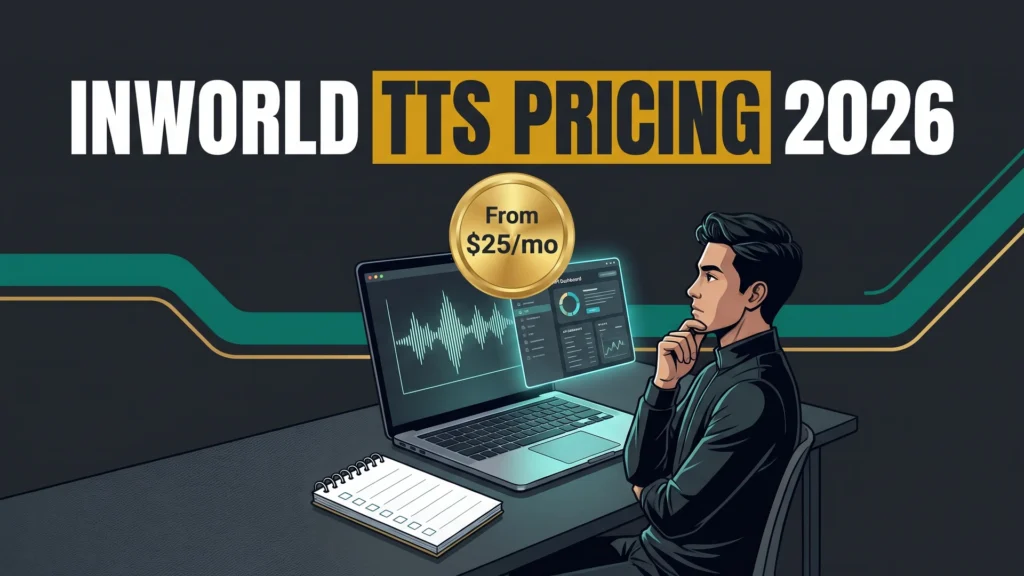
Inworld TTS Pricing in 2026: Plans Explained
Disclosure: this post contains affiliate links. If you buy through them, I may earn a commission at no extra cost to you. Prices checked November 18, 2026 — always confirm on the vendor’s own pricing page before you pay, because prices move.
I went looking for a straight answer on Inworld TTS pricing and kept hitting the same wall: most “pricing guides” out there are either stale, or they’re really about the old Inworld — the game-NPC company. That company is gone. What exists in 2026 is a realtime voice API business, and its pricing works nothing like ElevenLabs or Murf. So I read Inworld’s own pricing page live, line by line, and did the per-character math myself. Here’s what it actually costs — and who it’s actually for.
The short version
- Inworld TTS is API-only and priced per character, not per month of voice minutes. You buy credits; the monthly plan you pick sets your per-character rate.
- On-Demand is $0 — pay as you go at $25 per 1M characters for TTS-2 and $15 per 1M for TTS-2 Flash, with up to 70 minutes of TTS free to evaluate.
- The honest starting point is Creator at $25/mo, which drops Flash to $10 per 1M characters. Builder ($100/mo) is the plan Inworld marks “Popular”.
- Flash at $15/1M on-demand is the cheapest realtime TTS per character I’ve verified — ElevenLabs charges $40–$80 per 1M for its API voices, and Fish Audio’s API sits at $15/1M too.
- There’s no studio, no editor, no consumer app. If you want to click around and make a voiceover for YouTube, this is the wrong tool. If you’re building a voice agent or an app that talks, it’s one of the cheapest ways to do it.
- Unused credits roll over up to 3 months while you stay on an equal-or-higher paid plan — a real difference from subscription tools that wipe your allowance monthly.
Wait — what is Inworld TTS in 2026?
If you knew Inworld as the AI NPC company — the one behind character AI for games, with Xbox and Ubisoft partnerships — you’re not wrong, you’re just out of date. Between March and September 2025, Inworld retired its Character Studio product and rebuilt the company around voice and inference APIs. The docs page says it plainly: the legacy Character Studio has been retired.
What replaced it: Realtime TTS-2 (launched August 31, 2026) and TTS-2 Flash, plus a realtime speech-to-text model, a speech-to-speech endpoint, and an LLM inference router with 100+ models. The homepage now describes Inworld as “a research lab and inference provider for realtime AI at consumer scale.” In plain English: they sell voice infrastructure to developers now, not characters to game studios.
Why does this matter for a pricing article? Because anyone Googling “Inworld AI” expecting the old product will find a very different company — and because the pricing only makes sense once you know you’re buying API credits, not a voiceover app. There is no Inworld Studio to log into and record in. You (or your developer) call an API, and you pay per character the model speaks.
One more thing worth knowing before the numbers: Inworld repriced in October 2026, and the old TTS-1 models were retired in June 2026. A lot of the pricing pages ranking on Google right now still quote the old rates. Everything below comes from Inworld’s live pricing page, read on November 16, 2026.
Inworld TTS pricing at a glance
Every plan is credit-based. Your monthly fee buys credits equal to the plan price, and those credits get spent across TTS, speech-to-text, and LLM inference at your plan’s per-unit rates. Go over your credits and the overage bills at the same plan rate — there’s no penalty tier. Here’s the whole table:
| Plan | Monthly price | TTS-2 per 1M chars | TTS-2 Flash per 1M chars | STT per hour |
|---|---|---|---|---|
| On-Demand (pay as you go) | $0 | $25 | $15 | $0.15 |
| Creator | $25/mo | $20 | $10 | $0.10 |
| Builder (Popular) | $100/mo | $17.50 | $9 | $0.10 |
| Developer | $300/mo | $15 | $8 | $0.10 |
| Growth | $1,500/mo | $12.50 | $7 | $0.10 |
| Enterprise | Custom | As low as $5 | Under $5 | Custom |
Prices checked November 18, 2026, from inworld.ai/pricing.
What’s included on every plan — yes, even the $0 one: API access, audio downloads, voice cloning and voice design, 200+ languages, a commercial license, speech-to-speech access, and the LLM inference router. GDPR and SOC 2 Type II compliance come standard. Zero data retention kicks in from the Developer plan up, and HIPAA with a BAA is an add-on on Growth.
The plans, one by one
On-Demand — $0, pay as you go
This is the try-before-you-buy tier, and it’s genuinely usable. You pay nothing monthly and get charged $25 per million characters of TTS-2 or $15 per million of Flash. Inworld’s own FAQ says the plan includes up to 70 minutes of TTS or 400 minutes of speech-to-text free — that’s the evaluation allowance, and I couldn’t confirm whether it renews monthly or is a one-time grant, so treat it as one-time until Inworld says otherwise.
The limits that matter: 100 custom voices, 2 pro voice clones, 5 concurrent requests, and the TTS Playground caps at 2,000 characters per test (paid plans get 40,000). If you’re prototyping a voice agent or running a small side project, On-Demand is where you start. Just know that at $25/1M, TTS-2 on this plan costs more per character than ElevenLabs’ cheapest API voice — it’s the Flash model at $15/1M that makes On-Demand competitive.
Creator — $25/mo
This is the honest starting point for real use. Your $25 buys $25 of credits, but the rates drop: TTS-2 falls to $20 per 1M characters and Flash to $10. You get 500 custom voices, 4 pro clones, 10 concurrent requests, and the 40,000-character playground.
Do the math with me: $25 of credits at $10 per 1M Flash characters buys 2.5 million characters. Inworld’s own calculator treats roughly 1,000 characters as one minute of audio, so that’s around 2,500 minutes of Flash speech — or about 1,250 minutes of the higher-quality TTS-2 at $20 per 1M. For a small voice agent handling short customer calls, that’s a lot of talking for $25.
Builder — $100/mo (Inworld’s “Popular” pick)
Same structure, better rates: TTS-2 at $17.50 per 1M, Flash at $9. The jumps that justify the price are the scale limits — 3,000 custom voices, 10 pro clones, 50 concurrent requests. If your app is serving real users at the same time, concurrency is the number that bites first, and 50 is where Inworld starts to feel like production infrastructure rather than a hobby tier.
Developer — $300/mo
TTS-2 at $15 per 1M, Flash at $8, STT at $0.10 an hour. The plan also unlocks zero data retention — worth caring about if you’re handling user voice data and your lawyers ask questions. 10,000 custom voices, 25 pro clones, 150 concurrent requests.
Growth — $1,500/mo
TTS-2 at $12.50 per 1M, Flash at $7. 30,000 custom voices, 40 pro clones, 500 concurrent requests, HIPAA and BAA available as add-ons. At this level you’re negotiating, not shopping — and Inworld says price-matching is available on Enterprise, which tells you everything about where the real discounts live.
Enterprise — custom
TTS-2 as low as $5 per 1M characters, Flash under $5. SLA and DPA, EU and India data residency, a dedicated account manager and Slack channel, invoicing and purchase-order payment (everyone below Enterprise pays by credit card). If you’re generating tens of millions of characters a month, this is the only plan where the conversation matters — and the per-character price at this tier undercuts every name-brand competitor I’ve checked.
The free allowance — read the fine print
You’ll see some reviews say Inworld has “no free plan.” They’re half right. There is no monthly free allowance that refills — no “10,000 free characters every month” like ElevenLabs gives you. What exists is the On-Demand plan’s evaluation allowance: up to 70 minutes of TTS or 400 minutes of STT free. Several third-party reviews describe this as a one-time grant, and Inworld’s own page doesn’t spell out whether it recurs. My read: use it to test the voices and the latency, then expect to pay. If 70 free minutes is your whole budget, you’re not really evaluating a TTS API — you’re window-shopping, and that’s fine, but don’t build a product on it.
Three traps to watch before you pay
1. Per-character billing counts everything
TTS is billed per input character — and third-party reviews report that includes spaces, punctuation, and tags. That matters more than it sounds: a script full of SSML tags and long pauses costs more than the same words spoken plain. Inworld’s own rule of thumb is ~1,000 characters per minute of audio, but a tag-heavy script will run past that. If you’re comparing Inworld against a subscription tool that meters by minutes, use the character math, not the minute math — the two don’t line up neatly.
2. Rollover is real — but conditional
Unused subscription credits roll over for up to 3 months, which is genuinely good. Most subscription TTS tools wipe your allowance at the end of the month whether you used it or not. The catch is in the wording: rollover applies “while on an equal-or-higher paid plan.” Downgrade or cancel and your banked credits are gone. So rollover helps if your usage is lumpy month to month, but it’s not a savings account.
3. The annual discount is unverified — don’t count on it
Inworld’s FAQ confirms annual plans exist, but the live pricing page I read showed monthly prices only. One third-party source claims annual billing comes with two months free, but I couldn’t verify that anywhere on Inworld’s own site, so I’m not quoting it as fact. If an annual discount matters to your budget, ask Inworld’s sales team and get it in writing before you commit. The same goes for the Enterprise “as low as $5” rate — that’s a floor for negotiation, not a published price you can click to buy.
Inworld vs the field — the per-1M-character math
Comparing TTS tools is a mess because they bill differently: Inworld charges per character, Murf charges per hour of generation, Speechify charges per second of audio. The only honest common yardstick is the API cost per million characters, so that’s what this table uses. Where a tool doesn’t sell API characters directly, I’ve used its effective rate from its credit plan, used in full.
| Tool | Cheapest API / effective rate per 1M chars | What you get for it |
|---|---|---|
| Inworld TTS-2 Flash | $15 on-demand ($7 on Growth) | Realtime API, 200+ languages, cloning on every plan |
| Fish Audio s2.1-pro | $15 | API pay-as-you-go; Plus plan $15/mo ($11 annual) |
| Cartesia Sonic (Scale) | ~$37.38 | Credit plan; Pro starts at $5/mo |
| ElevenLabs Flash / Turbo | $40 | API; v4 and v3 cost $80/1M |
| ElevenLabs v4 | $80 | The flagship voice quality, at flagship prices |
| Murf Falcon API | $10 (single secondary source) | Studio-quality TTS API reported at $30/1M — treat both as unverified on Murf’s own page |
| Speechify Studio | n/a (credit-per-second model) | ~$4.17 per hour of audio on annual Starter ($100/yr) — reported, not vendor-confirmed |
Two things jump out. First, Inworld Flash and Fish Audio tie at $15 per 1M on-demand — but Fish gives you a studio app and a consumer product around it, while Inworld gives you an API and nothing else. Second, ElevenLabs’ best voices cost more than five times Inworld’s Flash per character. That gap is real, and it’s the whole reason Inworld exists: if your app generates a lot of speech and your users don’t need ElevenLabs’ specific voice quality, the savings are enormous at scale.
But — and this is the part the per-character table hides — ElevenLabs, Murf, Fish Audio and Speechify all bundle a usable product around their voices. Inworld doesn’t. You’re comparing a raw ingredient against a finished meal. The ingredient is cheaper. Whether that’s a good deal depends entirely on whether you have a kitchen.
For the subscription prices behind this table, my own price-checked guides cover ElevenLabs pricing (Starter $6/mo, Creator $22/mo), Murf pricing (Creator $29/mo, or $19/mo billed annually), Fish Audio pricing (Plus $15/mo, or $11/mo annual), Cartesia pricing (Pro $5/mo, Startup $49/mo, Scale $299/mo), and Speechify pricing (Studio Starter $100/yr, Creator $300/yr — reported figures, since Speechify’s own page shows no dollar amounts).
What does $25 a month actually buy you?
Let me make this concrete, because “credits” is the kind of word that hides the real cost. On the Creator plan, $25 of credits buys:
- 2.5 million Flash characters — roughly 2,500 minutes of speech at Inworld’s ~1,000 characters per minute. That’s about 41 hours of talking.
- 1.25 million TTS-2 characters — roughly 1,250 minutes, or about 21 hours of the higher-quality model.
- 250 hours of speech-to-text at $0.10 an hour, if you spend the credits on transcription instead.
Now compare that with what $25 gets you elsewhere. ElevenLabs Creator at $22 a month gives you about 121 minutes of voice. Murf Creator at $29 a month gives you roughly 2 hours a month of generation (24 hours a year). The gap isn’t small — it’s an order of magnitude. But remember what you’re giving up: ElevenLabs and Murf hand you an editor, a voice library you can browse, and a “press play” experience. Inworld hands you an API key. If you need 40 hours of speech a month, the API route wins on price by a landslide. If you need 40 minutes of voiceover for a YouTube video, the studio tools win on your time.
One more comparison that matters for builders: the Growth plan’s $7 per 1M Flash characters. At that rate, a voice agent handling 10,000 five-minute calls a month — about 50 million characters of speech — costs roughly $350 in TTS. The same volume on ElevenLabs’ v4 API would run about $4,000. That’s the kind of gap that decides architecture, not just budgets.
Three real-world scenarios — what you’d actually pay
Tables are abstract. Bills aren’t. Here’s what three different users would pay on Inworld, using the same ~1,000 characters per minute rule of thumb:
The indie hacker with a voice-agent side project
Say your agent handles 200 short calls a month, two minutes each — 400 minutes of speech, roughly 400,000 characters. On On-Demand Flash that’s $6. On Creator it’s $4 of credits against a $25 monthly fee — so really $25, but with 2.1 million characters of headroom left over. Compare: the same 400 minutes on ElevenLabs Creator ($22/mo, ~121 minutes included) would need overage or a bigger plan. Inworld wins, and it isn’t close.
The small business running a phone agent
Two thousand calls a month at three minutes each: 6,000 minutes, about 6 million characters. On Builder ($100/mo), Flash at $9 per 1M costs $54 in credits — inside the plan. On Creator ($25/mo), Flash at $10 per 1M costs $60, but you’d blow past the 10-concurrency limit at peak hours, so Builder is the honest pick. The same volume on ElevenLabs’ Turbo API at $40 per 1M would cost $240. On v4, $480. The gap pays for the integration work in the first month.
The content team that just wants voiceovers
Here’s where I stop you. A team producing 10 hours of narration a month — 600 minutes, ~600,000 characters — would pay $9 on Inworld Flash. Dirt cheap. But they’d also need to build or buy a pipeline: scripts in, audio files out, with retries, pronunciation fixes, and file management. Fish Audio Plus at $15 a month or Speechify Studio at $100 a year gives them all of that in a browser tab. Nine dollars of API credits plus a weekend of engineering is not cheaper than fifteen dollars of finished product. Know which buyer you are.
Who should use Inworld TTS — and who shouldn’t
Use it if: you’re building a voice agent, a talking app, a game with dynamic dialogue, or any product where speech is generated by code. If you need realtime latency (Inworld claims under 100ms to first audio for TTS-2 and 25ms for Flash — vendor claims, though an independent test measured around 168ms median), 200+ languages, voice cloning on every plan including the $0 tier, and a commercial license without paying extra, Inworld is genuinely hard to beat on price.
Skip it if: you want to make voiceovers for videos, audiobooks, or courses. There is no editor, no timeline, no “type text, download audio” workflow beyond a small playground capped at 2,000 characters on the free tier. You’d be paying a developer to build what Murf or Speechify already gives you. Also skip it if your team has no technical capacity at all — the $0 On-Demand plan looks free, but the integration work isn’t.
The middle ground: if you’re a solo builder prototyping a voice feature, On-Demand plus the 70 free minutes is a cheap way to test whether the voices and the latency feel right before you commit to a monthly plan. Just don’t mistake the prototype for the product — the moment real users show up, you’ll want at least Creator for the concurrency and the better rates.
Does Inworld have an affiliate program?
Yes — Inworld runs a partner program on PartnerStack, listed at up to 20% recurring commission (10% on the Growth plan), with a 90-day cookie and a 30-day payout hold. One honest flag: the sources disagree on how long the commission lasts. The PartnerStack listing says the first year; the program terms say for as long as the referred customer stays subscribed. I couldn’t read the live PartnerStack listing itself to settle it, so take “up to 20% recurring” as the safe version and check the listing at signup.
For now, Affitrove isn’t enrolled — PartnerStack rejected our earlier applications, and I won’t pretend a link exists when it doesn’t. The link below is a plain link to Inworld’s pricing page: inworld.ai/pricing. If the program opens up for us, I’ll update this section.
If you’re weighing Inworld against the tools it replaced in people’s workflows, my shutdown-replacement guides for Lovo and Vocode cover the same per-minute math for the wider TTS field.
Frequently asked questions
Is Inworld TTS free?
Partly. The On-Demand plan costs $0 a month and includes up to 70 minutes of TTS (or 400 minutes of speech-to-text) free as an evaluation allowance. After that, you pay per character — $25 per 1M for TTS-2, $15 per 1M for Flash. There’s no monthly free allowance that refills.
How much does Inworld TTS cost per month?
On-Demand is $0 (pay as you go). Creator is $25/mo, Builder $100/mo, Developer $300/mo, Growth $1,500/mo, and Enterprise is custom. Your monthly fee buys credits, and the plan you pick sets your per-character rate — the more you commit, the cheaper each character gets.
Is Inworld TTS cheaper than ElevenLabs?
Per character, yes — by a lot. Inworld Flash costs $15 per 1M characters on-demand versus $40 per 1M for ElevenLabs’ Flash/Turbo API voices and $80 per 1M for v4. But ElevenLabs bundles a studio, a voice library, and an editor; Inworld is API-only. Cheaper per character doesn’t mean cheaper for your use case if you need the product around the voice.
Can I use Inworld TTS commercially?
Yes — a commercial license is included on every plan, including the $0 On-Demand tier. That’s unusually generous; Cartesia, for comparison, reserves commercial use for its paid plans.
Does Inworld offer voice cloning?
Yes, on every plan. On-Demand includes 2 pro voice clones, Creator 4, Builder 10, Developer 25, Growth 40, and Enterprise 100+. Custom voices scale the same way, from 100 on On-Demand to 30,000 on Growth.
What happened to Inworld’s game NPC product?
Character Studio was retired between March and September 2025. Inworld pivoted to voice and inference APIs — TTS, speech-to-text, speech-to-speech, and an LLM router. If you’re looking for the old NPC tools, they no longer exist.
Do unused Inworld credits roll over?
Yes, for up to 3 months, while you stay on an equal-or-higher paid plan. Downgrade or cancel and banked credits are lost.
Is there an annual discount?
Inworld’s FAQ confirms annual plans exist, but I couldn’t verify any annual price or discount on the live pricing page, and the “two months free” claim comes from a single third-party source. Don’t budget on a discount until Inworld confirms it to you directly.
The verdict
Inworld TTS is the cheapest realtime voice I’ve verified per character — $15 per million for Flash on a $0 plan is a genuinely aggressive price, and $7 per million on Growth is the kind of number that makes voice agents affordable at scale. The rollover, the commercial license on every plan, and cloning from the free tier all point the same way: this is a developer-first product priced to win builders, not a consumer app priced to win YouTubers.
That’s also the honest limit. If you need an editor, a timeline, and a download button, buy Murf or Speechify or Fish Audio instead — you’ll pay more per minute and save hours of your life. But if you’re building something that talks — an agent, an app, a game — and you’re generating real volume, start on On-Demand, test the voices with the free 70 minutes, and move to Creator at $25 a month the moment it stops being a prototype. At that point the math isn’t close: nothing else in the field gives you this much speech for this little money.
Prices checked November 18, 2026. If anything here has changed by the time you read this, Inworld’s own pricing page is the source of truth — and if you spot a change, that’s exactly the kind of thing I want to know about.
References
- Inworld AI — Pricing (official, read live Nov 15, 2026)
- OpenAffiliate — Inworld AI partner program terms (read live Nov 15, 2026)
- TextToLab — Inworld TTS review (Nov 2026)
- TextToLab — ElevenLabs pricing (Oct 2026)
- TextToLab — Cartesia pricing (verified Nov 5, 2026)
- TextToLab — Fish Audio pricing (Oct 2026)
- ToolsGavel — Murf AI review (verified Oct 30, 2026)
- ToolsGavel — Speechify Studio (verified Oct 30, 2026)