Gemini TTS Pricing in 2026: Plans Explained
Disclosure: this post contains affiliate links. If you buy through them, I may earn a commission at no extra cost to you. Prices checked November 18, 2026 — always confirm on the vendor’s own pricing page before you pay, because prices move.
I went looking for a straight answer on Gemini TTS pricing and ran into the same problem I keep finding with Google’s AI products: the pricing page exists, but it reads like it was written for billing engineers. Token rates, four pricing lanes, promo rates with an expiry date, and a deprecation page that quietly moved a shutdown date since the last time anyone checked. So I read Google’s own pricing page live, line by line, and did the per-hour math myself. Here’s what Gemini TTS actually costs — and the January price rise you need to budget for now.
The short version
- Gemini TTS bills per token, not per minute. You pay for the text tokens you send in and the audio tokens that come back — 25 audio tokens per second of speech.
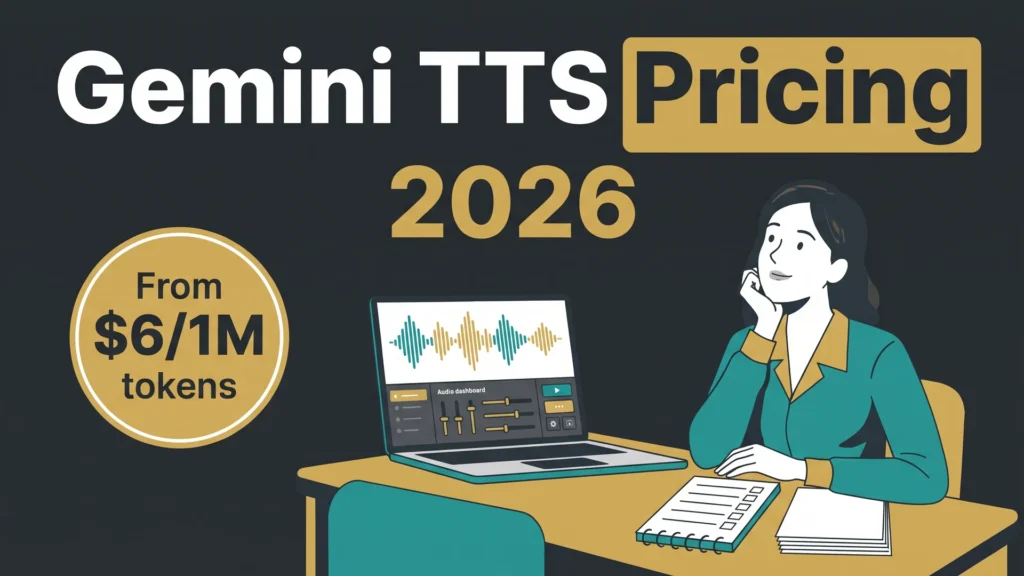
- Gemini 3.8 Flash-Lite TTS is the cheapest entry: $6 per 1M audio tokens ($0.54 an hour of audio). The flagship Gemini 3.8 Flash TTS is $9 per 1M ($0.81 an hour).
- Every 3.8 TTS rate doubles on Jan 1, 2027. Flash goes $9 → $18 per 1M tokens, Flash-Lite $6 → $12. Any budget you build on 2026 prices needs the 2027 number.
- The older preview models shut down Dec 18, 2026 — that’s the live date on Google’s own deprecations page today. Most guides still say Nov 17. They’re out of date.
- There’s a free tier, but Google doesn’t publish its limits. You can try TTS free in AI Studio; the exact per-project quotas only show up inside your own AI Studio project.
- There’s no Gemini affiliate program. This article earns Affitrove nothing from Google — the honest comparison to paid alternatives is where the value is.
Wait — what is Gemini TTS in 2026?
Gemini TTS is Google’s text-to-speech API, part of the Gemini API and Google AI Studio. You send text, you get back a WAV file of spoken audio. It’s not a studio app like Murf or Speechify — there’s no timeline, no editor, no “type and download” product page. You (or your developer) call an API and pay per token.
The current models are Gemini 3.8 Flash TTS and Gemini 3.8 Flash-Lite TTS, both released September 22, 2026. Google’s own guidance is simple: Flash TTS is the quality pick — audiobooks, studio narration, complex multi-speaker dialogue, dialects. Flash-Lite is the volume pick — voice agents, bulk read-aloud, anything where you’re generating a lot of speech and the price per hour matters more than the last bit of expressiveness.
Both models come with 30 prebuilt voices (Kore, Puck, Charon, Zephyr and 26 more, each with a one-word character like “Firm” or “Upbeat”), plus an Extended Voice Library Google describes as “hundreds” of additional voices across languages, accents and personas. Flash TTS covers 130+ languages, Flash-Lite 101 — and Flash-Lite skips a few, including Finnish, Swedish, Lithuanian, Slovenian and Swahili, so check your language before you commit to the cheaper model.
Two things set Gemini TTS apart from the subscription TTS tools. First, multi-speaker dialogue: one request can carry a two-person conversation, each turn tagged to a speaker, with style directions per turn. Second, style control that actually works like a director’s notes — you put sustained direction (“whispered urgently”, “speaking slowly”) in a style field, and point-in-time sounds like <laugh>, <sigh> or <long pause> as inline tags in the text. The text itself is treated as a verbatim transcript, so what you write is what gets said.
Gemini TTS pricing at a glance
Standard paid tier, per 1M tokens. Both sides are billed: text tokens in, audio tokens out. Audio runs at 25 tokens per second, so a minute of speech is 1,500 audio tokens and an hour is 90,000. Here’s the whole table, straight from Google’s pricing page:
| Model | Free tier | Text in / 1M | Audio out / 1M | Per hour of audio | From Jan 1, 2027 |
|---|---|---|---|---|---|
| Gemini 3.8 Flash TTS | Free of charge | $0.50 | $9.00 | $0.81 | $1.00 / $18.00 ($1.62/hr) |
| Gemini 3.8 Flash-Lite TTS | Free of charge | $0.50 | $6.00 | $0.54 | $1.00 / $12.00 ($1.08/hr) |
| Gemini 3.1 Flash TTS Preview | Free of charge | $1.00 | $20.00 | $1.80 | No change — retires Dec 18, 2026 |
| Gemini 2.5 Flash Preview TTS | Free of charge | $0.50 | $10.00 | $0.90 | No change — retires Dec 18, 2026 |
| Gemini 2.5 Pro Preview TTS | Not available | $1.00 | $20.00 | $1.80 | No change — retires Dec 18, 2026 |
Prices checked November 18, 2026, from ai.google.dev/gemini-api/docs/pricing. The per-hour figures are my arithmetic from Google’s published rates at 25 tokens per second — the text-input cost is so small (about $0.0001 per minute of speech) that it barely moves the number.
There are also three more pricing lanes on the same page, and they matter if you’re generating volume. Batch API costs exactly half of Standard — Flash TTS drops to $4.50 per 1M audio tokens through Dec 31 (then $9.00). Flex matches Batch pricing. Priority costs 1.8× Standard — Flash TTS at $16.20 per 1M through Dec 31 ($32.40 from Jan 1). Batch and Flex aren’t available on the free tier at all. All three lanes double on Jan 1, 2027, same as Standard.
The models, one by one
Gemini 3.8 Flash TTS — $9 per 1M audio tokens
The flagship, and the one most people should start with. $0.50 per 1M text tokens in, $9.00 per 1M audio tokens out — $0.81 for an hour of finished audio at the 2026 promo rate. 130+ languages, all 30 prebuilt voices, the full Extended Voice Library, voice design (describe a persona in text and get a voice), voice replication (clone from a reference recording with consent audio), and voice remixing (edit a voice with a text prompt — launched Nov 4, 2026, and it needs a paid Tier 1+ project). You can store up to 200 custom voices per project, and they expire after a year of no use.
The limits that matter: 8,192 input tokens and 16,384 output tokens per request. At 25 tokens a second, that’s about 10.9 minutes of audio per request — long scripts need splitting into chapters or scenes and joining afterwards. Output is a complete WAV file, 24 kHz, mono, 16-bit PCM, with a proper header. Raw PCM, mu-law and A-law are available too. What doesn’t exist: an MP3 output option. If your pipeline needs MP3, you convert with ffmpeg yourself.
Gemini 3.8 Flash-Lite TTS — $6 per 1M audio tokens
The budget model, and the honest pick for most bulk work. Same $0.50 text input, but audio output drops to $6.00 per 1M tokens — $0.54 an hour, the cheapest studio-grade TTS per hour I’ve verified anywhere. Same 30 voices, same voice design and replication, same 8,192/16,384 token limits, same WAV output. The trade-offs: 101 languages instead of 130+, and Google positions it for voice agents and bulk generation rather than audiobook-grade narration. If you’re building a voice agent that talks all day, the $3-per-million saving over Flash adds up fast — and the per-hour gap between $0.54 and $0.81 is 33%.
One practical note: the two 3.8 models are the only ones that support voice design, replication and remixing. The older preview models support none of them, which is one more reason the migration matters.
The preview models — retiring Dec 18, 2026
Gemini 2.5 Flash Preview TTS ($0.50/$10.00), Gemini 2.5 Pro Preview TTS ($1.00/$20.00, no free tier) and Gemini 3.1 Flash TTS Preview ($1.00/$20.00) all shut down on December 18, 2026. If your code or a tutorial you’re following still calls any of these model IDs, it stops working on that date — switch to gemini-3.8-flash-tts or gemini-3.8-flash-lite-tts.
Here’s the part worth flagging: most guides written in early November say the shutdown is Nov 17. That was Google’s earlier “earliest possible” date. Google’s own deprecations page, read live today, says December 18. The guides are stale; the date moved. There’s no auto-routing for the TTS previews either — unlike the chat models, which reroute to a replacement when they retire, the TTS endpoints just switch off. And migration isn’t only a model-ID swap: the old models took style directions inside the text itself, while the 3.8 models want them in the style metadata field, with the new angle-bracket tag format for laughs, sighs and pauses.
The Jan 1, 2027 doubling — budget for it now
This is the single most important fact in the article, and it’s the one most Gemini pricing guides bury or miss entirely. The $0.50/$9.00 and $0.50/$6.00 rates are introductory rates. Google’s pricing page prints both sets of numbers side by side: “through December 31, 2026” and “starting January 1, 2027”. On January 1, every 3.8 TTS rate doubles:
- Flash TTS: $9.00 → $18.00 per 1M audio tokens ($0.81 → $1.62 per hour)
- Flash-Lite TTS: $6.00 → $12.00 per 1M audio tokens ($0.54 → $1.08 per hour)
- Text input doubles too: $0.50 → $1.00 per 1M tokens
- Batch and Flex double as well ($4.50 → $9.00 for Flash TTS), and Priority goes to $32.40 per 1M
Two things to keep straight. First, the doubling applies to the 3.8 models only — the preview models show no January change because they shut down on Dec 18, before the doubling date. Second, the same doubling applies on the Google Cloud Text-to-Speech route, which lists the identical Gemini TTS rows. If you’re building a product on Gemini TTS, budget the doubled rate. The 2026 price is a six-week promo, not the price of the product. Even at the doubled rate, Flash-Lite at $1.08 an hour is still the cheapest TTS per hour I’ve verified — but “cheapest after doubling” is a very different budgeting conversation from “$0.54 an hour forever.”
The free tier — read the fine print
Yes, there’s a free tier, and it’s genuinely usable for testing: four of the five TTS models are free of charge on the Standard lane, input and output both. The exception is Gemini 2.5 Pro Preview TTS, which has no free tier at all. Batch and Flex are not available free on any model.
What I couldn’t verify — and what you should know before you plan around the free tier — is how much free usage you actually get. Google does not publish per-model free-tier request or token limits. Its rate-limits page says limits “can be viewed in Google AI Studio” and that published limits aren’t guaranteed. One tracker reports 3 requests per minute and 10,000 input tokens per minute for both 3.8 TTS models on the free tier, but that’s a single third-party source, not Google, so I won’t present it as fact. The honest version: open AI Studio, look at your own project’s limits, and treat the free tier as a testing lane, not a production plan.
Two more fine-print items. Free-tier data is used to improve Google’s products; paid-tier data is not. If you’re generating speech from private scripts on the free tier, that’s the trade you’re making. And the paid tier needs billing linked — spending caps sit at $10 per 10 minutes on Tier 1 and $200 on Tiers 2 and 3, per Google’s rate-limits page. One more thing that trips people up: the $300 Google Cloud trial credit cannot be spent on Gemini API or AI Studio usage. Don’t plan a free trial around it.
Three traps to watch before you pay
1. You’re billed on both sides of the conversation
Most TTS tools charge per character or per minute of audio. Gemini charges for the text tokens going in and the audio tokens coming out. In practice the text side is nearly free — a minute of speech is roughly 130–150 words, about 200 text tokens, about a hundredth of a cent. But the structure matters for a different reason: the audio side is billed at Google’s own token count, 25 tokens per second. One independent test measured closer to 32 tokens per second of actual consumption. Your invoice follows Google’s count, so budget on 25 — but if your usage looks higher than the math suggests, that measurement gap is probably why.
2. There’s no MP3, no speed slider, and no context window
Three features people assume exist, and none of them do. Audio comes back as WAV (or raw PCM) — no MP3 option is documented anywhere, so your pipeline needs a conversion step. There’s no numeric speaking-rate parameter; pace is controlled with natural-language style directions (“speaking slowly”) and punctuation, not a 0.25×–4× slider. And the TTS models have no general context window — the 8,192-token input limit is the whole input cap, not a 1M-token context like the chat models. If a guide quotes a million-token context or MP3 output for Gemini TTS, it’s describing the wrong product.
3. The preview shutdown has already been moved once
Google moved the preview shutdown from Nov 17 to Dec 18 after early-November guides went to print. That tells you two things: check Google’s deprecations page yourself before you trust any date in this article, and don’t build anything new on a preview model ID. The same page also shows the chat models Gemini 2.5 Pro and 2.5 Flash auto-routing to Gemini 3.8 Flash on Dec 1, 2026 — that’s the chat side, not TTS, and the two shouldn’t be confused. If you’re reading a guide that says Gemini 2.5 Pro TTS “reroutes” on Dec 1, it’s mixing up the products.
Gemini TTS vs the field — the per-hour math
Comparing TTS tools is a mess because they bill differently: Gemini charges per token, Inworld per character, ElevenLabs and Murf per subscription credits, Speechify per second of audio. The only honest common yardstick is the cost of one hour of finished audio, so that’s what this table uses. Where a tool doesn’t sell audio by the hour directly, I’ve used its effective rate from its credit plan, used in full. Competitor prices below were checked on the dates noted — I did not re-verify every one live today, and the article says so next to each.
| Tool | Cheapest way in | Cost per hour of audio | What you get for it |
|---|---|---|---|
| Gemini 3.8 Flash-Lite TTS | PAYG, no subscription | $0.54 ($1.08 from Jan 1, 2027) | API only, 101 languages, 30 voices, 2-speaker dialogue |
| Gemini 3.8 Flash TTS | PAYG, no subscription | $0.81 ($1.62 from Jan 1, 2027) | API only, 130+ languages, voice design + cloning |
| OpenAI gpt-4o-mini-tts | PAYG, no subscription | ~$0.90 | API only; shuts down Jan 6, 2027 — replacement is gpt-realtime-2.1-mini (secondary sources, Sept–Nov 2026) |
| Fish Audio API (S2.1 Pro) | Plus $15/mo ($11 annual) | ~$1.25 | API + studio; cloning on every plan incl. Free (checked Nov 12, 2026) |
| Inworld TTS-2 Flash | On-Demand $0 | ~$0.90/hr (Flash $15/1M chars) | API only, realtime, 200+ languages, cloning on every plan (checked Nov 16, 2026) |
| Cartesia Sonic (Pro $5/mo) | Pro $5/mo | ~$2.40 | API + playground; ~90ms first-audio latency claim (secondary sources, Oct 2026) |
| ElevenLabs Creator ($22/mo) | Starter $6/mo | ~$10.90 | Full studio, voice library, editor, v4 quality (checked Oct–Nov 2026) |
| Murf Creator ($29/mo) | Creator $29/mo | ~$14.50 | Full studio, timeline editor, 24 hrs/yr generation (checked Nov 12, 2026) |
| Speechify Studio Starter ($100/yr) | Starter $100/yr annual-only | ~$4.17 | Studio + API; Reader Premium is a separate personal-use product (checked Nov 12–13, 2026) |
Read that table carefully, because it flatters Gemini and I don’t want it to mislead you. The per-hour ranking is real — Gemini Flash-Lite at $0.54 an hour is roughly twenty times cheaper than ElevenLabs Creator per hour — but the subscription tools bundle a studio, a voice library you can browse, an editor, and a download button. Gemini hands you an API key and a WAV file. If you need 40 hours of speech a month, the API route wins on price by a landslide. If you need 40 minutes of voiceover for a YouTube video, the studio tools win on your time. My own comparisons of Fish Audio, Murf and Speechify cover the studio side in full if that’s what you need.
One more comparison worth making: the other Google option. Google Cloud Text-to-Speech is a different product from Gemini TTS, and it bills per character, not per token. Its classic voices run $4 per 1M characters (Standard/WaveNet) up to $160 (Studio voices), with Chirp 3 HD at $30 — and the first 1–4M characters a month are free depending on the voice. If you’re already on Google Cloud and you want SSML control and a simple per-character bill, Cloud TTS is the steadier product. If you want the 30 expressive Gemini voices, style prompts and two-speaker dialogue, Gemini TTS is the one — and note that on the Cloud route, Gemini TTS rows carry the same token prices and the same Jan 1 doubling, with no free usage at all.
Three real-world scenarios — what you’d actually pay
Tables are abstract. Bills aren’t. Here’s what three different users would pay on Gemini TTS, at the 2026 promo rates and then at the doubled 2027 rates:
The indie hacker adding voice to an app
Say your app reads out short summaries — 200 sessions a day, 30 seconds each. That’s 100 minutes of audio a day, 3,000 minutes a month. On Flash TTS that’s 3,000 × $0.0135 = $40.50 a month. On Flash-Lite it’s $27 a month. From January, those become $81 and $54. Compare: the same 3,000 minutes on ElevenLabs Creator ($22/mo, about 121 minutes included) would need overage or a much bigger plan, and on Fish Audio’s API at ~$1.25 an hour it’d be about $62.50. Gemini wins, and the gap survives the doubling.
The content team narrating articles and courses
Ten hours of narration a month — 600 minutes. Flash TTS: $8.10. Flash-Lite: $5.40. From January: $16.20 and $10.80. Dirt cheap either way — but here’s the catch I keep coming back to. You also need to build or buy a pipeline: scripts in, audio files out, retries, pronunciation fixes, file management, and MP3 conversion, because Gemini hands you WAV. Fish Audio Plus at $15 a month or Speechify Studio at $100 a year gives you all of that in a browser tab. Eight dollars of API credits plus a weekend of engineering is not cheaper than fifteen dollars of finished product. Know which buyer you are.
The voice-agent builder running real call volume
Two thousand calls a month at three minutes each: 6,000 minutes. Flash TTS at $0.0135 a minute costs $81 a month in 2026, $162 from January. Flash-Lite: $54, then $108. Batch API halves those numbers if your workload tolerates async processing — Flash-Lite on Batch would be about $27 a month in 2026. The same volume on OpenAI’s gpt-4o-mini-tts at ~$0.015 a minute runs about $90 — but that model shuts down Jan 6, 2027, so it’s not a plan, it’s a countdown. On Inworld’s Flash at $15 per 1M characters, roughly 6 million characters of speech costs about $90. Gemini is the cheapest of the three at 2026 rates, and still the cheapest after the doubling — just budget the doubled number from day one.
Who should use Gemini TTS — and who shouldn’t
Use it if: you’re building a voice agent, a talking app, a read-aloud feature, or anything where speech is generated by code. If you need 130+ languages, two-speaker dialogue, style prompts that actually steer the performance, and the cheapest per-hour audio I’ve verified, Gemini TTS is genuinely hard to beat — even after the January doubling. The free tier makes it cheap to test, and the Batch lane halves the price again if your workload can wait.
Skip it if: you want to make voiceovers for videos, audiobooks, or courses without writing code. There is no editor, no timeline, no “type text, download audio” workflow beyond the small AI Studio playground. You’d be paying a developer to build what Murf or Speechify already gives you — and you’d be converting WAV files to MP3 yourself. Also skip it if your team has no technical capacity at all: a $0.54-an-hour API looks free until you count the integration work.
The middle ground: if you’re a solo builder prototyping a voice feature, the free tier in AI Studio is a cheap way to test whether the voices and the quality feel right before you link billing. Just don’t mistake the prototype for the product — the free tier’s limits are unpublished and per-project, and the moment real users show up you’ll want a paid tier. And whatever you build, budget the doubled 2027 rate from day one, not the promo rate.
Does Gemini have an affiliate program?
No — there is no affiliate or referral program for the Gemini API or Gemini TTS specifically. I checked, because the question comes up in every pricing guide and the answer matters: this article carries no Gemini affiliate link, and there isn’t one to add. One warning that belongs here: “Gemini” the crypto exchange does have an affiliate program (around $25 per converted account). That’s a different company entirely. Don’t click a “Gemini affiliate” link in a Google Gemini article — it’s the wrong Gemini.
The adjacent program is the Google Cloud Affiliate Program, run through CJ Affiliate for US and Canada affiliates, which pays per new eligible Google Cloud user referred. It rewards Cloud sign-ups generally, not Gemini API usage, the commission amounts aren’t published on the program page, and the $300 trial credits it offers can’t be spent on Gemini API usage anyway. It’s a weak route for a TTS article, and Affitrove isn’t enrolled — so the link below is a plain link to Google’s pricing page: ai.google.dev/gemini-api/docs/pricing. The affiliate value in this article is the comparison traffic — if Gemini’s per-hour price makes you look twice at the studio tools, my pricing breakdowns for ElevenLabs and Cartesia are where those links live.
If you’re weighing Gemini against the wider TTS field, my shutdown-replacement guides for Lovo and Inworld TTS pricing cover the same per-hour math for the tools Gemini competes with.
Frequently asked questions
How much does Gemini TTS cost?
Gemini 3.8 Flash TTS costs $0.50 per 1M text tokens in and $9.00 per 1M audio tokens out — about $0.81 per hour of audio. Gemini 3.8 Flash-Lite TTS costs the same $0.50 in and $6.00 out, about $0.54 per hour. Both rates double on Jan 1, 2027, to $18 and $12 per 1M audio tokens.
Is Gemini TTS free?
Partly. Four of the five TTS models are free of charge on the Standard lane in AI Studio, including both current 3.8 models. Google doesn’t publish the free tier’s request or token limits — they show up per-project inside AI Studio. The free tier is for testing; production use needs billing linked.
When do Gemini TTS prices double?
January 1, 2027. The 2026 rates are introductory: Flash TTS $9 → $18 per 1M audio tokens, Flash-Lite $6 → $12, text input $0.50 → $1.00. Batch, Flex and Priority lanes double too.
When do the old Gemini TTS models shut down?
Gemini 2.5 Flash Preview TTS, Gemini 2.5 Pro Preview TTS and Gemini 3.1 Flash TTS Preview all shut down on December 18, 2026, per Google’s deprecations page read live today. Most guides still say Nov 17 — that date moved. Switch to gemini-3.8-flash-tts or gemini-3.8-flash-lite-tts.
Is Gemini TTS cheaper than ElevenLabs?
Per hour of audio, yes — by a lot. Gemini Flash-Lite costs $0.54 an hour versus roughly $10.90 an hour on ElevenLabs Creator. But ElevenLabs bundles a studio, a voice library and an editor; Gemini is API-only. Cheaper per hour doesn’t mean cheaper for your use case if you need the product around the voice.
Can I use Gemini TTS commercially?
The paid tier is a commercial API — you’re paying per token for generated audio. The free tier’s data is used to improve Google’s products, which is a different trade. Google’s pricing page doesn’t attach a separate commercial-use restriction to the paid TTS models, but check the Gemini API terms of service for your own use case before shipping a product on it.
Does Gemini TTS support voice cloning?
Yes, on the two 3.8 models: voice replication clones from reference audio with consent, voice design creates a voice from a text description, and voice remixing edits a voice with a prompt. Up to 200 custom voices per project, with a one-year expiry that resets on use. The older preview models support none of these.
Does Gemini TTS output MP3?
No. Output is WAV (24 kHz, mono, 16-bit PCM) by default, with raw PCM, mu-law and A-law available. There’s no documented MP3 option — convert with ffmpeg if your pipeline needs MP3.
The verdict
Gemini TTS is the cheapest studio-grade voice I’ve verified per hour — $0.54 an hour on Flash-Lite, $0.81 on Flash, with a free tier to test in and a Batch lane that halves the price again. The 30 voices, 130+ languages, two-speaker dialogue and real style control make it a serious tool, not a toy demo. For builders generating real volume, nothing else in the field gives you this much speech for this little money.
But the honest version of that verdict has two asterisks, and they’re both dates. The price doubles on January 1, 2027 — budget $1.08 and $1.62 an hour, not $0.54 and $0.81. And the old preview models switch off on December 18, 2026 — if your code still calls them, it breaks. Build on the 3.8 models, budget the doubled rate, and start on the free tier to test the voices before you link billing. At the doubled rate Gemini is still the cheapest per hour I’ve verified — it’s just no longer the price the headline promises.
Prices checked November 18, 2026. If anything here has changed by the time you read this, Google’s own pricing page is the source of truth — and if you spot a change, that’s exactly the kind of thing I want to know about.
References
- Google Gemini API — Pricing (official, read live Nov 16, 2026)
- Google Gemini API — Speech generation / TTS guide (official, read live Nov 16, 2026)
- Google — Gemini 3.8 Flash TTS model page (official, read live Nov 16, 2026)
- Google Gemini API — Deprecations (official, read live Nov 16, 2026)
- Google Gemini API — Rate limits (official, read live Nov 16, 2026)
- Google Cloud Text-to-Speech — Pricing (official, read live Nov 16, 2026)
- Google AI Studio — Try TTS free (official)
- OpenAI API pricing (via secondary reads, Sept–Nov 2026)